Tuesday, August 24, 2010

MoodleMeet Moodle’rrific

The posting below is an invitation to participate in the upcoming online conference, Moodle'rrific. Please pass it forward to colleagues who may be interested in getting involved.

Word is out that you have developed some successful practices around online learning and we’re hoping that you would be willing to share some of your ideas with colleagues in the upcoming MoodleMeet Moodle’rrific: taking place online between Sept 17-24, 2010.

The purpose of Moodle’rrific is to bring educators from across the world to ‘show and tell’ their successful online practices bringing together innovative uses of technology and personalized. Some of our partners this week include: British Columbia (Canada) Ministry of Education,Commonwealth of Learning*, and CUE BC, .with other partners and individuals still signing on.

We invite you to join this growing team as we work together leading the way  internationally to:

- ensure that educators have access to a network of colleagues to help one another be the best they can be as online or mixed-mode educators

- ensure that students have access to engaging and effective online courses There are several ways you can join us ranging from being a participant during the week, being a “show and tell’ presenter during a 30-min
Elluminate timeslot and being part of the threaded discussion on the topic, and/or being an organizer/facilitator.

We know September 17th is fast approaching and no doubt you’re busy with back-to-school preparations; however, our facilitating team is ready to assist you and to bring you into the event in whatever level of participation interests you.

Please contact me if you have any questions, or want more information. Join us, you’ll be glad you did!

Sent by Sharon Betts on behalf of the Moodle’rrific Team, sharonbetts[@]gmail.com


Monday, August 23, 2010

Are you a Web Whore?

Are you a web whore? Read this interesting blog post and see if you could relate to Leo, http://leoville.com/buzz-kill

Let's see if I qualify as one...

Leo joined twitter in 2006. I think I joined in 2007
Leo "sign up for every site, try every web app, use every service I can find". I don't sign up to every web app I find or learned from my web friends, only those that I fancy.

Leo: "I love trying the myriad new ways people are using it to connect and I believed that social media specifically had some magic new potential to bring us together." Me too and I agree that social media connects people, hence the term 'social'?! Hello?...

Leo: "When Google announced Buzz last year I was one of the first to jump on the bandwagon." I didn't. I guess I didn't hear the buzz...

Leo: "Buzz exclusively, replacing Twitter, Friendfeed, and Facebook"  I didn't use Buzz or Friendfeed. Been using Facebook and twittr, and I have never been unfaithful--well, not yet...

Leo: 17,000 people followers. Wow- impressive. I think I'm more of a 'follower' than the one being followed. Though my tweet numbers may say otherwise, http://twitter.com/motherchina

Leo: use Feeds. I used it and I think I still have my feed site somewhere but I never really get the hang of it.

Leo: "But I ignored my blog and ran off with the sexy, shiny microblogs." I did too, and also ran off with twitter and FB. But now, like Leo, I find myself going back to blogging- tiptoeing my way back.

Leo: "Screw you Google Buzz. You broke my heart" I can't say the same to Google Buzz. Didn't ran off with buzz. So far, I'm enjoying the company my network of social media brings me. In this world of 'change' and social mobility, tech tools come and go, but  what I find interesting and yes motivating and sometimes heartwarming is no matter which web tool I use or web space I land in, a handful of webheads are ALWAYS there to accompany me with my online journey. Joining the bandwagon are a few IATEFL folks that keep me good company too- making the tweets I get even more stweeter :-)

So, am I web whore? Well, are you? If you're interested in technology and its uses in the language classroom, you don't have a choice but to try the tools that are out there. You're gonna be doing a lot of 'sign ups', trying lots of web apps, transferring files from here to there, shifting from one task to another, etc. If you count all these as being 'unfaithful' and 'web promiscuity', well, then I am guilty as charged. Don't be so judgemental, I'm sure you've got your little secret tucked in somewhere. You're digital footprints could lead us to the web paths you've taken, and then we could see and judge...

Aiden

How Fairy Tale Ends: Ideas for Language Writing Tasks

Hi All,

This was forwarded to me by my sister-in-law. It's just for fun, but I think it

(the idea) can be used as a writing/speaking activity. Some points to consider:

- Write a paragraph or brief essay (which could be posted on blogs/wikis/google

docs) about

  • fairy tales vs practical/cruel realities of life
  • childhood stories- when to start/end believing in them
  • describe the story behind the picture/s (easy task)
Anyway, perhaps you could think of other better ideas :-)

Aiden
----

How fairy tales really end:

Cinderella


Snowwhite


Little Red Riding Hood

Sleeping Beauty


Jasmine: Aladdin


Link:


Belle: Beauty and the Beast


The Little Mermaid


Seems like only yesterday...


BARBIE DOLL has her 50th birthday this year......


Tweety Bird is 60 years old!


Link: http://ragsnram.com/wp-content/uploads/2010/03/image010.jpg

What about our superheroes?


Superman


Read: 25 Ways to Tell You're Grown Up,


Cheers,


Aiden

Saturday, July 31, 2010

Sue Waters Keynote Presentation Webconference

Reform Symposium
http://reformsymposium.com/blog/2010/07/10/keynote-sue-waters/
Saturday, 7/31/2010, 12 noon
Day 1 Closing Keynote: Sue Waters

By Christopher Rogers, on July 10th, 2010

Sue Waters is Australian based in Perth and is married with two kids. While her work as an aquaculture lecturer, at Challenger TAFE, earned her the vote of the coolest job title Sue’s passion is the use of technology to enhance student learning.

Sue’s technology use has changed considerably since she was first introduced to it’s potential in 2000; from a LMS (WebCT) to Virtual Classrooms (Elluminate), mobile technologies (spyglasses, PDAs, iPods) and Web 2.0 (blogs, wikis etc).

Her passion for technology has lead to Sue’s transition from aquaculture lecturer, to facilitating professional development workshops on elearning and web 2.0 technologies to her current role as editor of The Edublogger and working for Edublogs as Edublogs Community Facilitator.

While she does spend considerable time helping and mentoring others — she does make time for for her personal and family life. Sue’s favorite ways of relaxing are reading a good book or going to a movie at the cinema.

As a blogger Sue stands for — practical application of technologies in education, and most importantly HELPING OTHERS learn how to use these technologies.

Date & Times: Fri. July 30th 9pm-10pm LA/ 12am Sat. NYC/ 5am, Sat. 7/31, London/ 6am, Sat. Paris/ 2pm, Sat., Sydney/ 1pm, Sat., Tokyo

Click here to join the Keynote: https://sas.elluminate.com/m.jnlp?sid=2008350&password=M.CFE71A28898F87AA1A007FBC9CFA49


Keynote’s Website: Sue Waters, http://suewaters.com/
Twitter: @SueWaters


21C learning environment

Shelly Blake Keynote
Keynote: What We Do


Description: A view from the classroom and a conversation about what 21C learning looks like on the ground level. There will be many examples of the practical and everyday use of Twitter, Jing, Wave, Blogs, Wikis, and more as used by students and teachers alike as well as a look at how to transform the physical space of the classroom into a 21C learning environment conducive to collaboration, mobile computing, and tech-integrated differentiated instruction.

Date & Times: Fri. July 30th 7pm-8pm LA/ 10pm NYC/ 3am, Sat. 7/31, London/ 4am, Sat. Paris/ 12noon, Sat., Sydney/ 11am, Sat., Tokyo

Click here for more time zones!

Click here to join the Keynote: https://sas.elluminate.com/m.jnlp?sid=2008350&password=M.3A2AF29E985C9DD57501D645EE19D0

http://reformsymposium.com/blog/2010/07/10/keynote-shelly-blake-plock/

Friday, July 30, 2010

David Nunan TESOL Seminar: Motivating Young Learners

Reform Symposium

Showcasing Innovation in Education


The Reform Symposium is a free online conference for educators, administrators, parents and students. This year the conference is focused on innovative practices in education and what role these practices can play in educational reform.

Online presentations, http://reformsymposium.com/

Saturday, July 17, 2010

Smories

As posted on the Young Learners SIG Yahoo! Group list:

[1] We've now started adding subtitles - see these smories:

http://www.smories.com/winners/

[2] From May onwards, a new smory will be published daily, and all will be subtitled.

[3] The "Submit your own flimed smory" functionality is now live on the site. We still can't take external readers for stories submitted by writers, but we CAN take films of kids reading their own stories.

It's all done in a kids-safe environment. Instructions are available on the main menu on http://www.smories.com/.

The direct link is here: http://www.smories. com/submit/ video/

Best wishes,
- Ralph

Friday, July 16, 2010

The POST Method: A systematic approach to social strategy

The POST Method: A systematic approach to social strategy

by Josh Bernoff


What do most companies do wrong when they enter the social world? No, it's not that they're being fake, or don't "get it." It's that they don't really know their objectives.


Is your company doing its social strategy backwards?


If you started by saying "we should do a blog" or "we should create a page on a social network" or "we should create a community" the answer is probably yes.


In any other business endeavor we start by figuring out what we want to accomplish. Social technologies are not magic. They accomplish things, too. It's time to stop doing social because it's cool. It's time to start doing it because it's effective.

Read full article here, http://forrester.typepad.com/groundswell/2007/12/the-post-method.html

APA Cogniive Taxonomy

Click on the link to view graphic from APA website,
http://www.apa.org/Images/cognitive-taxonomy-circle_tcm7-74268.gif

Comment posted on Cris's blog

Hi Cris,


I'm still trying to finish my own PhD race. Although I am in my last leg of the race, I feel that I have already consumed my last energy pack. After writing the first five chapters, working on the last one is not as easy as I thought it would be. I need to consolidate all the ideas that I've presented in the previous chapters, but I find myself running out of things to say.

I started this race back in 2004. 'worked on my pilot study, survey, and case study. Then by early 2006, I took a Leave of absence due to personal reasons. Miki (my husband) decided to subspecialize in Nephrology which would take 2 years. I was only able to continue my studies after he got his subspecialty certificate- that was in 2008. Using the data gathered in 2005 were still useful but I felt I needed to spruce things up. So, I did another survey, a replicate of the 2005 survey, and a new case study. I'm hoping that I did the right move, and that I'm presenting something that is worthy of a PhD degree.

Cris, I could almost see the finish line; It's near and yet so far...will I be able to make it before my energy pack totally runs out?

Sunday, July 11, 2010

Invitation to listen to David Crystal on the British Council Isle in Second Life

Posted on behalf of Graham Stanley


We are pleased to announce that two talks by renowned linguist David

Crystal next week which will be retransmitted live to people on the

British Council Isle in Second Life


Details are here:

http://www.scribd.com/doc/34172281/David-Crystal-Second-Life-July-2010

1) Speaking Shakespeare: Fact and Fiction

A light-hearted romp through Shakespeare


Prof. David Crystal and Hilary Crystal


WHEN: Monday, July 12, 2010 at 5.00pm UK time

see http://www.timeanddate.com/worldclock/ for local time


WHERE: British Council Isle

http://slurl.com/secondlife/British%20Council%20Isle/213/223/30


2)Myths and realities of English on the Internet

by Prof. David Crystal

The internet, the language linker par excellence, offers ELT fresh

opportunities and challenges, but to respond to these requires an

understanding of how language is evolving in electronic media. The

talk examines some of the myths about what is happening to English in

electronic communication, and discusses research realities.


WHEN: Tuesday, July 13, 2010 at 9am UK time - see

http://www.timeanddate.com/worldclock/ for local time

WHERE: British Council Isle

http://slurl.com/secondlife/British%20Council%20Isle/213/223/30

PARTICIPATION:

To participate in the event, join us at the British Council Isle in

Second Life:

Anybody (over 18) can access the Main Grid island by downloading the

Second Life software from www.secondlife.com

Creating an avatar is free and takes 15 minutes. Once you've

registered and downloaded the software, teleport directly to the event

by clicking on the following link in your browser:

http://tinyurl.com/3xnrjo2


For more information on Second Life for English learners and teachers

have a look here:

www.teachingenglish.org.uk/try/links/second-life-learners-teachers-english

HOSTS and ORGANISERS:

David Crystal will be speaking live at ETAI's 6th International

conference, Linking Through Language (see http://tinyurl.com/24z2vho

for more information)

Looking forward to seeing you on the island!

------------------
As posted on the webheads list

Saturday, July 10, 2010

Web 3.0- the Video


Web 3.0 from Kate Ray on Vimeo.

Structure is needed to make sense of all the data we have on he Internet. Information overload can be overwhelming- and people tend not to engage or drop the whole thing (stop reading or sharing) simply because there's too much information going around!

Thursday, July 08, 2010

Letter from the Chair

Here's a copy of Letter from the Chair which I wrote as part of the NNESTIS newsletter first issue for 2010,

Dear NNESTIS members,

Now in its third year as an interest section, NNESTIS is still going strong! At the recent TESOL convention in Boston, our IS was very well represented. With 29 sessions this year, compared with the 25 sessions we did in 2009, it just goes to show that our members have still got a lot to say about the issues that we advocate for. Below is a list of hot topics that we will be discussing at TESOL 2011 (New Orleans):

•Examining the “E” in TESOL
•Employment issues in Asia
•Native speaker and color in the workplace
•Tomorrow with an E: that is, how NNES teachers can compete with NES teachers in the teaching profession
•Reviewing previous studies and envisioning the future of NNESTIS
•Topics related to other ISs can include NNEST focus
•How the NNEST issue is affecting everyone in the field
•Analysis of policies in other organizations
One of the items on my to-do list is to conduct a series of free webinars for our members. The first session, held on April 23, 2010, and entitled “Webinar on Writing Good Proposals for the TESOL Convention,” was for those who may be interested in submitting a proposal but don’t know how. We were very fortunate to have Past Chair Karen Newman and Robert Griffin to share with our members some tips and tricks. Unfortunately, Valerie Jakar was unable to do her presentation because of illness. However, we’re planning to put up a slidecast and podcast of her session soon, which will also be available for download. PowerPoint materials used in the session and a link to the recording of the webcast can be accessed at http://nnest2010webinar1.pbworks.com.


The next webinar in the lineup is about improving presentation skills. Having your proposals get accepted is just the beginning. Making sure that you’re able to present your session well is just as important. Learn what it takes to impress an audience. Details about this webinar will be posted to the NNESTIS e-list.


In addition to the webinars, I am also planning to do another Electronic Village Online (EVO) session for 2011. Please look at the EVO session we offered back in 2009 (http://nnest-evo2009.pbworks.com). For EVO2011, I’d like to organize an online workshop for NNES teachers who wish to enhance their teaching skills. The focus will be on teaching practice(s) in the local context. I’d like to see more EFL teachers participate and share with us how they teach and what they teach. If you’re interested in helping out in the planning process, please get in touch with me.

If you look at the list of hot topics above and at the topics of our webinars and online workshop, you will notice that we’d like to cover a wide scope of issues. Yes, it is true that discrimination against teachers who are labeled as nonnative speakers is still rampant and sometimes we see it right under the wings of TESOL. However, we should bear in mind that although we are very much interested in the issues regarding nonnative speaker status, we cannot deny the fact that they are interconnected with the issues of other interest sections in TESOL. We need to deal with these issues from the inside out. As a group we are united because despite the differences in the color of our skin, the beauty of our own first language(s), and the unique sound of our accents, we see one common ground that bonds us together: These differences unite us. These differences define who we are. And as long as we value these differences as our strength, we can serve the larger EFL/ESL community much better without losing our own identity in the process.

I am hoping that through the webinars, online workshops, and face-to-face conference presentations, NNESTIS can help empower you so you can help us empower teachers in the larger EFL/ESL communities areas all over the world. As we think global, we spread our vision to the world. We do this by working with local TESOL affiliates to gain access to local teachers. And with the power of new technologies, teacher professional development is just a click away. It’s time to think “glocally.” And it’s time for all of us to pay it forward.

Aiden Yeh

NNEST Newsletter 2010 Volume 12 Number 1: Table of Contents

Saturday, May 15, 2010

Stephen Krashen: Children need food, health care, and books. Not new standards and tests.

Stephen Krashen: Children need food, health care, and books. Not new standards and tests.
By Anthony Cody on May 10, 2010 10:36 AM | 8 Comments | No TrackBacks
Dr. Stephen Krashen is a professor emeritus at the University of Southern California. He has written numerous books on his research into literacy and language acquisition. In recent years he has emerged as a persistent voice pointing towards the basic steps we should take to build literacy and strong academic skills for our students. He also points out the flaws in many of the premises of the "school reform" movement. This week, I asked him to share some thoughts with us on where things are headed. He offers us his views in this guest post.

Read full article here,
http://blogs.edweek.org/teachers/living-in-dialogue/2010/05/stephen_krashen_fix_poverty_an.html

Arizona Education Loses The Accent Of America

NPR: Andrei Codrescu wonders what America would be like if public figures with accents, like Albert Einstein, had their contributions eliminated from the American landscape.

From the PD list:

TESOL released a joint statement with its AZ affiliate, AZ-TESOL, today regarding the initiative by the AZ Department of Education mandating teachers with accents be removed from classes with English language learners. The statement is below.


Joint Statement on the Teacher English Fluency Initiative in Arizona
May 2010

According to recent media reports, the Arizona Department of Education has mandated that teachers whose spoken English it deems to be heavily accented or ungrammatical must be removed from classes for students still learning English. It is reported the intent of this initiative is to ensure that students with limited English have teachers who speak the language flawlessly.

For decades the field of English language teaching has suffered from the myth that one only needs to be a native English speaker in order to teach the English language. The myth further implicates that native English speakers make better English as a second language (ESL) or English as a foreign language (EFL) teachers than nonnative English speakers because native English speakers are perceived to speak “unaccented” English and understand and use idiomatic expressions fluently. The distinction between native and nonnative speakers of English presents an oversimplified, either/or classification system that is not only misleading, but also ignores the formal education, linguistic expertise, teaching experience, and professional preparation of educators in the field of English language teaching.


TESOL has long opposed discrimination against nonnative English speakers in the field of English language teaching. All English language educators should be proficient in English regardless of their native languages, but English language proficiency should be viewed as only one criterion in evaluating a teacher’s qualifications. English language proficiency, teaching experience, and professionalism should be assessed along a continuum of professional preparation; pedagogical skills, teaching experience, and professional preparation should be given as much weight as language proficiency.

TESOL and its Arizona affiliate AZ-TESOL have great concerns about this teacher English fluency evaluation initiative and its impact upon English language learners. Nonnative English-speaking educators should not be singled out because of their native language, nor evaluated based on arbitrary standards of language fluency. All educators should be evaluated in a transparent manner along the same criteria based on clearly articulated and valid standards. The TESOL-NCATE Standards for P–12 Teacher Preparation Programs, which provide standards and rubrics designed to help teacher education programs identify evidence of teacher performance, can be useful resources for institutions.

With the recent state legislation targeting undocumented immigrants in Arizona (SB 1070) and other legislation banning ethnic studies in Arizona (HB 2281), TESOL and AZ-TESOL are deeply troubled by what appears to be an environment of fear and xenophobia being fostered by lawmakers in the state without consideration of the consequences upon student learning and achievement. This impacts all educators and students, including U.S. citizens and legal permanent residents who speak a language other than English. The right of undocumented students to a K–12 public education has long been protected under U.S. law. TESOL and Arizona TESOL strongly urge lawmakers and education officials in Arizona to ensure that the education of all Arizona schoolchildren is not harmed by these developments, and that the right of all educators to be treated fairly and equally is protected.

#####

Color, Race and English Language Teaching: Shades of Meaning - edited by Andy Curtis and Mary Romney, exploring the intricacies of being a TESOL professional of color. Whose language? Whose authority?

http://books.google.com/books?id=D0IAov9RElsC&pg=PA137&lpg=PA137&dq=%22color+race+and+english+language+teaching%22&source=web&ots=B5knevT-EX&sig=EEHNDuxwCH9xs33FbI_MRDPsHBA#v=onepage&q&f=false

Friday, July 17, 2009

Voices for Diversity and Equal Opportunity in ELT


Presented By British Council Signature Event
Session Details
British Council Symposium on Equal Opportunity and Diversity in ELT: Getting it Right - took place on 20/21 February 2009 at the British Council, Spring Gardens in London

Demonstrating a willingness and commitment to discuss, understand and promote equality of opportunity and valuing, managing and promoting diversity in the ELT staffroom and classroom context are a challenge but have never been more important. Finding space for discussion and others to share in this commitment can be equally challenging.

Please visit the IATEFL site for details, http://iatefl.britishcouncil.org/2009/sessions/63/voices-diversity-and-equal-opportunity-elt

Wednesday, June 17, 2009

Online (and Distance) Design

Day 2: June 16

Discussion Topic: Online (and Distance) Design -


As an instructor and student of online classes, I have not have much hand at designing or contemplating what can be used in the design of an online learning environment. From what I have seen in e-mails directed to this discussion I find it is utterly amazing and there are so many possiblitities. I liked the "Survey Monkey" Janet put in the discussion.... what a great site! I will definitely find a use for it! Thank you Dr. Rosen for the tip regarding the instruction movies on the site http://www.mlots.org . There is some great stuff that has come my way without even looking for it!


I guess from the stand-point of someone who has taken online classes and has instructed using them, I find the more user-friendly, the better; interactive sites, where drawings are made, (such as demonstrating angles, acute, obtuse, etc.), or where feed-back or answers are given, are great learning tools; use of graphics to teach things is a spectacular teaching tool. I have found that when I review some suggested sites, I learn new ways of explaining things, or ways to make the explanation clearer in my own teaching. It seems the internet has a great future for teaching and is a great tool for teachers.


When a lot of the discussion seemed slanted to those designing or facilitating the design of online professional development, I didn't know if it was a place I belonged. But, it is a great adventure reading the comments and visiting other areas, and a lot of places I was unaware of! I find it is a great learning experience and I look forward to all of the discussions.

Wednesday, April 08, 2009

Live Session on Teaching Speaking to Seniors

Terry Doyle will be giving a brief talk about 'teaching speaking/oral skills to seniors' today at 5 am GMT in Learning Times, http://tinyurl. com/y3eh

Here's a link to his ppt.

http://www.slideboom.com/presentations/57376/Teaching-English-to-Seniors

Link to recording is at
https://sas.elluminate.com/p.jnlp?psid=2009-04-07.2223.M.7AE801FFB697DA460D4BF25AA8C21B.vcr

Wednesday, March 18, 2009

Learning English Kids Website

As posted by the British Council:

There are some new materials on the
British Council's LearnEnglish Kids website.
This month we have a new story. It's a
traditional tale from West Africa called
'Why Anansi has thin legs'. Anansi is a
spider, and to find out why his legs are
so thin you'll have to listen to the story!

There are some lovely flashcards and a
reading and writing worksheet to accompany
it: http://www.britishcouncil.org/kids-stories-anansi.htm

Students are also given the opportunity
to write a traditional story from their
country. They can send it in to us and
we will put the best ones up on the site.
It will be great to be able to read traditional
stories written by children all over the world,
so please encourage your students and/or
children to take part and send us a story:
http://www.britishcouncil.org/kids-your-traditional-stories.htm

As spring time arrives (on this side of the
earth anyway!) we'd like to remind you
about the activities based on the topic
of seasons which you'll find here:
http://www.britishcouncil.org/kids-topics-seasons.htm

Finally, a reminder, that you'll find lots
of tips for how to get the most out of
the material and topics on LearnEnglish
Kids, on the TeachingEnglish website.
Here's the link to the Teaching Children
section:
http://www.teachingenglish.org.uk/try/resources/teaching-children

Wednesday, March 11, 2009

Guest Speaker for Cindy's Live Session

Here's a brief bio of Terry Doyle.


Terry Doyle has been an ESL teacher at City College of San Franciscosince 1978. He has taught all of those years but one in non-credit classes. These classes include many retired seniors, He teaches all levels and skills, but he specializes in using authentic movies to teach ESL. He has also collaborated with another teacher on organizing a Video Drama club. He graduated from UC Berkeley with an MA in linguistics, from San Francisco State University with a MA in TESOL, and from the University of San Francisco with an EdD in Multicultural and International Education. His dissertation was on language maintenance among Chinese families in San Francisco. His research interests center on NNEST issues and intercultural communication and the connection between these two. He is also currently compiliing a Movie-Idioms dictionary which he plans (with the help of some weboholic) to put on a website.

Cardiff Online

Posted on behalf of Gavin Dudeney,
-----------

Join us for IATEFL Cardiff Online - 'one of the biggest global teacher
development events ever'

The Cardiff Online website is now live at:

http://iatefl. britishcouncil. org/2009

The 'Cardiff Online' project is British Council / IATEFL partnership
which will provide online conference coverage of this year's Cardiff
IATEFL Conference.

If you can't attend the Cardiff conference, follow the event online!

Cardiff Online will provide teacher audiences worldwide with an
opportunity to share ideas with colleagues before, during and after the
conference.

Please see below for some background information, which I hope you`ll
find useful.

Hope you can join us!

Julian Wing
British Council Cardiff Online Project Manager

~~~~~~~~~ PROMOTING CARDIFF ONLINE ~~~~~~~~~~~~ ~

We'd like to encourage Teacher Associations, ELT institutions and ELT
bloggers to carry a link to Cardiff Online on their website, newsletter
or blog so we can spread the message and encourage more people to take
part in Cardiff Online.

We've produced some web banners which are available in different shapes
and sizes on the Cardiff Online website at:

http://iatefl. britishcouncil. org/2009/ cardiff-promotio n

~~~~~~~~~ CARDIFF ONLINE BACKGROUND ~~~~~~~~~~~~

IATEFL CARDIFF CONFERENCE: CARDIFF ONLINE WEBSITE NOW LIVE!

Online conference coverage of the 43rd IATEFL Conference

The Cardiff Online website is now live at:

http://iatefl. britishcouncil. org/2009

The British Council and IATEFL have launched the Cardiff Online website
which offers web coverage of this year's 43rd IATEFL Annual Conference
in Cardiff.

The Cardiff Online website allows remote participants to take part in
one of the world's biggest ELT conferences through a variety of
resources including:

- Video recordings of selected sessions
- Audio recordings of selected sessions
- Live streamed plenaries and events
- Moderated special interest discussion forums
- Chat sessions
- Blogs and photo albums

To visit the Cardiff Online website, go to:

http://iatefl. britishcouncil. org/2009

This initiative builds on the earlier collaboration between the British
Council and IATEFL.

Last year, 1,600 teachers and trainers attended the Exeter IATEFL
Conference, and over 5,000 participated online.

This year we expect a much larger audience, and this is a real
opportunity to take part in the biggest online ELT training community.

The Cardiff Online website gives you an opportunity to share ideas with
teachers all around the world. There will be interactive coverage with
video presentations, reports and interviews 'almost live' from Cardiff.

We look forward to meeting you online, and hope that you will share this
information with your colleagues worldwide.

Gavin Dudeney - Honorary Secretary, IATEFL
Julian Wing - British Council Cardiff Online Project Manager
Nik Peachey - IATEFL Online Editor

~~~~~~~~ IATEFL Press Release - March 2009 ~~~~~~~~~~

There are many thousands of professionals for whom attending the
conference is usually no more than a dream because of the costs involved
in travel to UK. This year plans are afoot to make the event accessible
to many thousands more participants from around the globe through a
virtual community space, known as 'Cardiff Online'

http://iatefl. britishcouncil. org/2009

This initiative builds on the groundwork laid at our two previous
conferences. It is an exciting and truly ground-breaking innovation made
possible through collaboration between IATEFL and The British Council,
and one that is very much in line with the charitable aims of IATEFL. It
promises to be one of the biggest global teacher development events
ever.

So what happens? A teacher in Mongolia, or Nepal, Venezuela or Ethiopia
will be able to sign up and participate in the conference from their own
country. All the plenary talks, as well as a sizable number of other
presentations will be shown live over the Net or recorded and made
available on the conference site. We will also have forums to discuss
all aspects of our profession, photo albums, chat sessions and prizes
especially for our remote participants. A large team will be in place
behind the scenes to bring the event to the remote audience, which is
anticipated to be in the region of 20,000 participants.

This year certainly promises to be different.

Marion Williams

President, IATEFL

Gavin Dudeney - Project Director, The Consultants- E

c/ Ceramica 54, 08035 Barcelona, Spain

Tel: +34 93 427 4240 | +44 20 7193 0770

http://www.theconsu ltants-e. com

Sole Online Providers: CertIBET and CertICT - http://tinyurl. com/3s3mm7

Winners: 2007 British Council ELTON award - http://tinyurl. com/3e2c54

Winners: 2007 Ben Warren Trust Prize -
http://tinyurl. com/6yolo4

Owners: Second Life EduNation sims - http://tinyurl. com/34l8mw

CONFIDENTIALITY AND DISCLAIMER NOTICE

This email and any attachments are private and confidential. It is intended
for the recipient only. If you are not the intended recipient, any use,
disclosure, distribution, printing or copying of this email is unauthorised.
You may not read, use or take any action in reliance on it. If you have
received this email in error please notify the sender immediately by
replying to this email and permanently delete the email from your computer.
The contents of any attachments to this e-mail may contain software viruses
which could damage your own computer system. While we have taken every
reasonable precaution to minimise this risk, we cannot accept liability for
any damage which you sustain as a result of software viruses. You should
carry out your own virus checks before opening any attachments.

Saturday, February 21, 2009

Six Inspirations to become a teacher

Philip Kerr's Six Inspirations to become a?teacher

This blog entry was posted at the IATEFL'S Teacher Education Sig list. It talks
about the 6 inspirations of Philip Kerr. Read this short blog entry, and see if
you agree with him. Read the comments area, too. Take note of the teacher who
got robbed in Thailand, and see where she landed next.

What inspired you to become a teacher?

Go to the blog, click here.

Friday, August 08, 2008

Motivating Young Learners Workshop

Motivating Young Learners!
如何激發青年學子的潛力

A workshop led by Olha Madylus 英語教師研習工作坊

Why, if children are actually born with the necessary skills to be successful learners, do so many fail to reach their potential?

Organised by the British Council, this presentation addresses this dilemma. First examining the abilities children are born with, then exploring what happens when children are thrown into that unnatural and bizarre establishment – school. Practical classroom strategies (which teachers can easily integrate into their own classrooms), for children aged 7-17, based on the idea that challenge, fun and success are vital ingredients in shaping children’s attitude to learning and ability to do well will be presented.

如果孩童都與生俱來成功的學習技能,為何還有許多無法發揮其潛力的例子呢?

此工作坊為英國文化協會主辦,將針對這個主題,深入探討孩童出生時已具備的能力,以及進入『學校』這個學習環境後所面臨的挑戰。同時,講師將為國內教導7-17歲孩童的英語教師,分享實用的課堂教學策略- 強調具挑戰性、趣味性、及成功的教學方法為塑造孩童成功學習的重要關鍵因素!

講員介紹:

Ms. Olha Madylus英語教學經驗豐富,在英國擔任國際英語EFL教師證照CELTA之講師,同時也是劍橋大學考試局 (Cambridge ESOL) 國際專業導師。曾受邀至很多非英語系國家擔任英語講師及顧問,並且培訓當地學校英語教師,對兒童英語教學相當有研究。目前是師資訓練專家,經常受邀到世界各地演講,深受歡迎。

日期與時間:2008年 8月15日,星期五 下午13:00 – 16:00 [ 13.10-14.30 & 14.45-16.00]

地 點:集思會議中心 柏拉圖廳〔台北市羅斯福路四段85號B1〕

報 名 方 式 :歡迎您免費報名參加!請填妥下列報名表格,利用傳真 或是電子郵件寄至吳小姐 ,Evelyn.Wu@britishcouncil.org.tw即可,我們會盡快與您確認報名。詳情請洽詢英國文化協會,Tel: 02 8722 1027 ; Fax: 02 8786 0985。


姓 名


服務學校/ 職業


聯絡電話

E-mail


聯絡地址


※ 前來參加完成研習的英語教師,將可申請多元研習時數共三小時。

※ 英國文化協會將提供”閱讀的魔力”讀本致贈與會貴賓,歡迎有興趣的老師踴躍報名參加!

活動場地交通資訊:


集思會議中心 柏拉圖廳 http://www.meeting.com.tw/;捷運公館站出口2

Monday, July 28, 2008

Links to Logging Classroom Observations

http://www.humboldt.edu/~tha1/observ.html
http://del.icio.us/aidenyeh/classroom_observation

Tuesday, December 25, 2007

Tuesday, May 15, 2007

EFL Teachers' Perceptions of English Language Policy at the Elementary Level in Taiwan

EFL Teachers' Perceptions of English Language Policy at the Elementary Level in Taiwan

CONNECT conference announcement

On behalf of Vance Stevens

This is to remind you of the free online conference starting in a
few days, May 17/18-20.

Our theme this year is CONNECT: Conversations on Networking,
Education, Communities, and Technology, and though not specifically
mentioned in the theme, many members of the Webheads community of
practice, http://webheads. info, are practitioners in language
learning.

This is the second time our community has hosted a free online
conference. You can replay the first one at http://2005. wiaoc.org

This year we kick off in a pre-show event at 22:00 GMT May 17, with
the start of a Webcastathon hosted by http://www.worldbri dges.net.
The conference itself starts at midnight GMT May 18 (evening of May
17 in the USA) with a keynote speech by Leigh Blackall and continues
for three days with more talks by Stephen Downes, George Siemens,
Etienne Wenger, Robin Good, Barbara Ganley, Teemu Leinonen, and many
other presenters whom you can see on the schedule at
http://schedule. wiaoc.org.

To attend the conference you can register for free at
http://www.webheads inaction. org and use the calendar there or the
schedule link above, or our online help pages, to work out how to
access the presentations and make comments or join forums. The will
be a voice stream of most events available at
http://www.webheads inaction. org , as well a live chatroom for use
during the conference, and we hope to have someone live online
available to assist you at any time during the conference at
http://www.tappedin .org

We look forward to your joining us May 17/18-20 for this unique
adventure in online professional development. We hope it will be
educational and F.U.N.

Vance Stevens
WiAOC Coordinator

Tuesday, May 08, 2007

creativity

Posted by Dr. Rossem, ALPDD List

If you are a teacher, does your program or school nourish creativity
and innovation? If so, how does this happen?

If you are a professional developer, how do your professional
development efforts nourish creativity and innovation?

Does your state ABE system nourish these? If so, how?

How do _you_ nourish creativity and innovation in your work and in
the work of your colleagues?

You will find at

click here


a list of possible sources � and examples � of teacher creativity
and innovation in adult literacy education.

What other sources and examples are you aware of?

To contribute your ideas of sources or examples, reply to this
message on the Professional Development discussion list and/or add
them to the above wiki page.

The Adult Literacy Education Wiki page,


has been updated

Parents' Attitudes Towards Bilingual Education Policy in Taiwan

Parents' Attitudes Towards Bilingual Education Policy in Taiwan

http://taiwanmatters.blogspot.com/

http://taiwanmatters.blogspot.com/

Languages in Taiwan Today

Languages in Taiwan Today

Issue of Language Policy

http://www.taipeitimes.com/News/taiwan/archives/2002/03/26/129253/print

Language Ideology in Taiwan

Language Ideology in Taiwan: The KMT’s
Language Policy, the Tai-yü Language
Movement, and Ethnic Politics

Chinese Language Attitudes Survey

Survey cover letter

Saturday, April 21, 2007

An interview with Nicky Hockly, Consultants-E

An interview with Nicky Hockly, Consultants-E
Click here

Teaching EFL in Primary Schools through blended and distance learning

Teaching EFL in Primary Schools through blended and distance learning
Sophie Ioannou-Georgiou (Cyprus)

Abstract
The presentation shows how blended or distance learning can be used to enhance the EFL learning and teaching in not‐so affluent or technologically‐rich primary schools. Examples of synchronous and asynchronous e‐learning will be shared as well as the pedagogical and technological challenges posed by such a project.

Click here

YL Content-based teaching of young learners: possibilities of assessment

YL Content-based teaching of young learners: possibilities of assessment
Sanja Wagner (Germany)

Abstract
Working in a group on a content‐based task, presenting the outcomes and thereby using the target language,is a very complex performance. In this talk I will show how descriptors from the CEFR and ‘rubrics’ can help both teachers and pupils assess, not only the results, but also the manifold competences during project work.

Click here

Graded/levelled readers = effective scaffolding in EFL. Some concrete evidence!

Graded/levelled readers = effective scaffolding in EFL. Some concrete evidence!
Wendy Arnold (Hong Kong)

Abstract
This talk will present the interim results of a longitudinal classroom research project using a published levelled reading scheme across keystage 2 (aged 9‐12, total 400) in a Hong Kong government‐aided primary school. The students are monolingual, homogenous, mixed ability and mixed gender. The study tracked the students for three years with formative and summative data.

Click here

50 ways to improve your international presentations

50 ways to improve your international presentations
Bob Dignen (UK)

Abstract
50 Ways to Improve Your International Presentations is a new book from Summertown Publishing. It isprimarily a self‐help manual for professionals but also provides excellent classroom material for teachers. The presentation will introduce the critical success factors for international presentations and demonstrate how the book can enable professionals to develop their international effectiveness.

Click here

Flash needed

Saturday, April 07, 2007

More links

Chu

Hsu


THE IMPACT OF MULTIMEDIA ENVIRONMENTS ON SELF-CONFIDENCE OF LOW-ACHIEVERS WITH FOREIGN LANGUAGE ANXIETY


Qualitative Report

Mixed methods
Reconstructing English Language Teaching in Taiwanese English Departments: An Interface between language and literatu

http://privatewww.essex.ac.uk/~gopric/res.html

A STUDY OF TEACHERS’ CONCERNS WHEN
IMPLEMENTING AN INNOVATION IN TAIWAN
CALL Technologies and the Digital Learner:
Introduction
John I. Liontas


http://www.ingentaconnect.com/content/routledg/ceds/2006/00000032/00000003/art00003

The Language Barrier?
Accent, Ethnicity and Ideology
In Taiwan’s ESL Education.


Taiwanese NNS


Native and Non-native: Who is more ideal? An Investigation of College Students・Appraisal of Native and Non-Native Speaker Teachers in the Classroom


EFL teachers’ perceptions of English language policy at the elementary level in Taiwan
http://www.aare.edu.au/04pap/wei04067.pdf

http://www.spz.tu-darmstadt.de/projekt_ejournal/jg-11-1/beitrag/Merkelbach1.htm

http://www.gio.gov.tw/taiwan-website/5-gp/yearbook/2001/chpt17-3.htm

More links

http://ist.colostate.edu/posters/ho_secondary_teachers.pdf (poster)

Intro to EFL


http://www2.dokkyo.ac.jp/~esemi029/articles/VideoingImpact.htm

Explorations in Language and Literacy
Learning: A Two-Year Case Study on a
Nine-Year-Old Chinese-English
Bilingual Child’s Chinese Invented


The politics of language names in Taiwan


Rethinking the English Pedagogy at Hope College in Taiwan

More readings

The fourth reason for claiming that English-language education in Taiwan is punctuated with confusion can be found in another recent major decision made by the central education authorities. Due to an acute shortage of communicatively proficient local English-language teachers, the government proposed in 2003 to embark upon a program of mass recruitment of native speakers to teach in elementary and junior high schools in the country.

http://www.chu.edu.tw/~wswu/publications/papers/journals/04.pdf (blogs)

http://www.academicjournals.org/err/PDF/pdf%202007/Mar/Huang.pdf

http://eprints.qut.edu.au/archive/00000510/01/crawford_teacher.PDF

http://www.buxiban.com/faqTW.asp

http://fredshannon.blogspot.com/2005/10/filipinos-teaching-english-in-taiwan.html

Teaching English from Elementary School in an Asian Context: A Language-planning Perspective

Inside the English Language Schools in Taiwan

Taiwanese English speakers will develop a distinct creole language which may be called. Taiwan English or China English, depending on the prevalent global political situation and. attitudes towards language and identity. (Quirk, 1990; ...

More links

Foreign language anxiety

LANGUAGE USE OF BEGINNING STUDENTS IN A TAIWANESE ENGLISH IMMERSION PRESCHOOL


List of journals

Exploring the Effectiveness of Implementing
Cooperative Learning and CAI at Hsing-Wu College


http://www.eng.ntnu.edu.tw/ConcentricLinguistics/PDF/Vol.28/No2828.pdf

More reading links

台南市國小英語教師教學態度及教學策略取向之分析[An. analysis of elementary school English teachers’ teaching attitudes and teaching approaches in. Tainan City]. Unpublished master’s thesis, National Tainan Teachers College, Taiwan. ...

http://etds.ncl.edu.tw/theabs/site/sh/detail_result.jsp

http://www.english.com.tw/modules/weblog/index.php?user_id=2

http://www.springerlink.com/content/a6l71450l8l476rm/

paraphrase differences between the Chinese translations and the original English form ... Elementary school teachers’ attitudes toward sex. education. The Journal of Sex Education in Taiwan, 3(2), 1-20. ...

New links to readings

http://www.hss.nthu.edu.tw/~fl/thesis/tesol/905259.pdf

Taiwan’s High School Education: High School Students’ Performances in Their Study Plans and Interviews

教育部 ( 民95 )。國民中小學九年一貫課程綱要。中華民國95年3月10日台國(二)字0950030031C號令修正國民中小學九年一貫課程綱要-語文學習領域(英語)

http://www.edu.tw/EDU_WEB/EDU_MGT/EJE/EDU5147002/9CC/English-1.doc


教育部國教司( 民89 )。國民中小學九年一貫課程綱要 語文學習領域-英語 課程目標

http://www.edu.tw/EDU_WEB/EDU_MGT/EJE/EDU5147002/9CC/English-1.doc

Codeswitching


Gill, S. & Rebrova, A. (2001). Native and non-native: together we’re worth more. ELT Newsletter. Retrieved July 20, 2004, from http://www.eltnewsletter.com/back/March2001/art522001.htm

Maum, R. (2002). Nonnative-English-speaking teachers in the English teaching profession. ERIC Digest. Retrieved April 2, 2005 from http://www.cal.org/ericcll/digest/0209maum.html.

Zhou, J. (1999). How can a Chinese teacher of English succeed in oral English classes? The Internet TESL Journal, 5(7). Retrieved March 2, 2005, from http://iteslj.org/Articles/Zhou-SuccessfulTeacher.html

Saturday, March 04, 2006

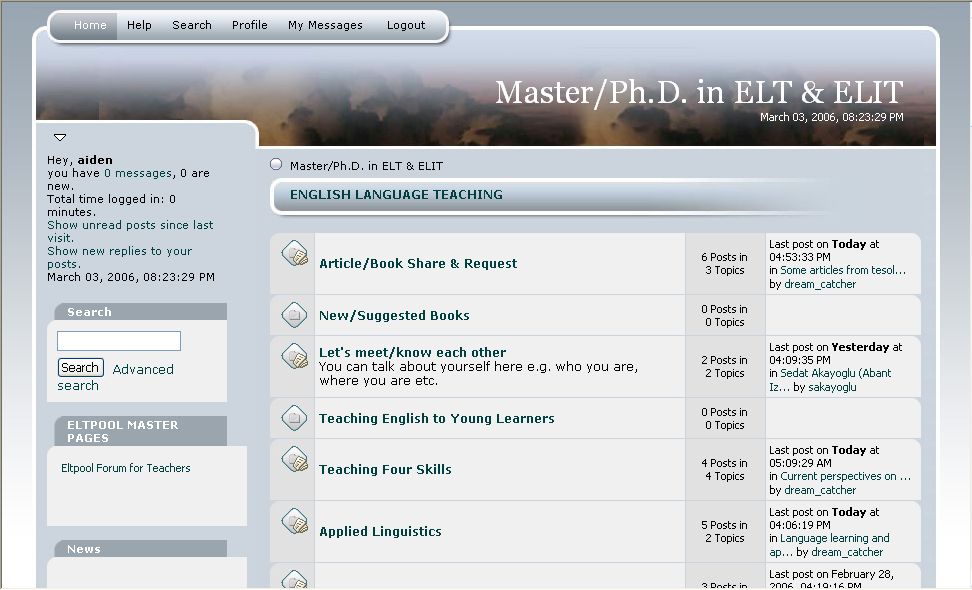
Master/Ph.D. in ELT & ELIT, English Language Teaching Posted by Picasa

Web Casts from TESOL's Electronic Village 2006

Web Casts from TESOL's Electronic Village 2006

Dear colleagues,

Connect with the 40th Annual TESOL Convention and Exhibit (TESOL 2006) March 15-18, 2006 in Tampa, Florida, USA. If you cannot be there in person, join the Convention goers virtually. For the first time, the CALL Interest Section has organized 4 presentations and 2 interviews to be web cast from the Electronic Village in Tampa. You will be able to hear CALL experts Tom Robb, Randall Davis, Leslie Opp-Beckman, and Chris Jones present their Web projects. By clicking on the links to their presentations, you can follow along and also participate in a text chat. If you have a microphone and a Skype connection, you will be able to ask questions of the presenters directly. Please click the link below to see the schedule of web cast presentations.

Schedule of Web Casts, March 16 and 17, from the Electronic Village—Internet Fair Classics

Please click here for Instructions for Participating in the Web Casts.

We are looking forward to your participation during these events.

The Web Cast Organizers
Jeff Lebow (www.Worldbridges.com) and Christine Bauer-Ramazani
We thank TESOL, the CALL-IS, the Electronic Village team, and the Electronic Village Online Coordinators for their on-site assistance with these events.

Distributed on behalf of TESOL EV Online Coordinating Team

Friday, January 20, 2006

Taipei Times - archives

Taipei Times - archives: "English teacher plan falls short
OFF-MARK: A program launched in 2003 aimed to place 1,000 foreign English teachers in the nation's public schools, but only 40 teachers have been placed so far
By Mac William Bishop"

Monday, December 12, 2005

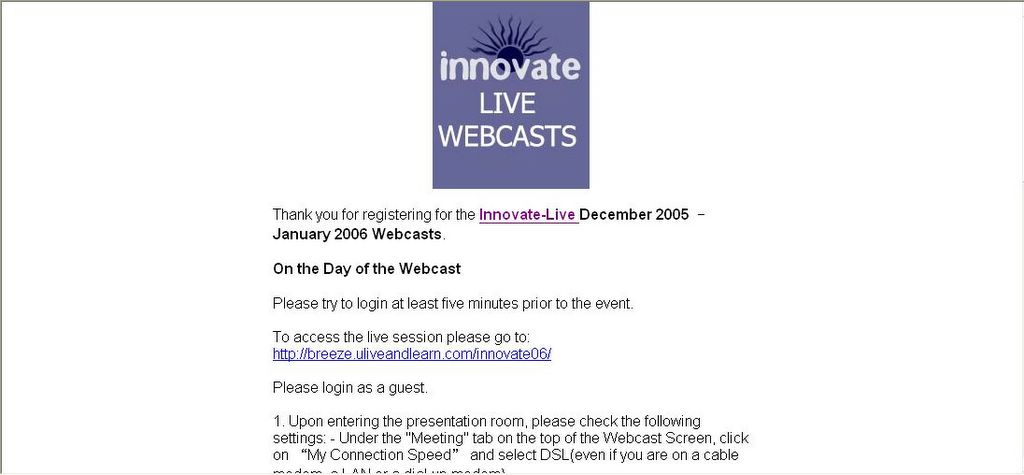
Innovate Live Webcasts

Scheduled Webcasts Applying Gaming and Simulation Techniques to the Design of Online Instruction
Carolyn Rude-Parkins, Karen Hughes Miller, Karen Ferguson, and Robert Bauer
December 12, 2005, 12p.m.EST

Technology and Pedagogy: Building Techno-pedagogical Skills in Preservice Teachers
Lorraine Beaudin and Corey Hadden
December 12, 2005, 1p.m. EST

Taking a Journey with Today's Digital Kids: An Interview with Deneen Frazier Bowen
James L. Morrison and Deneen Frazier Bowen
December 14, 2005, 1p.m.EST

Implementing Organic Education: An Interview with Hugh Osborn
James L. Morrison and Hugh Osborn
January 10,2006, 3p.m. EST

Designing e-Portfolios To Support Professional Teacher Preparation
Tu Tran, Robert Baker, and Margo Pensavalle
January 11, 2006, 3p.m.EST

All times are in EST. The world clock site http://www.worldclock.org might be helpful in converting to your specific time zone.  Posted by Picasa

Saturday, October 29, 2005

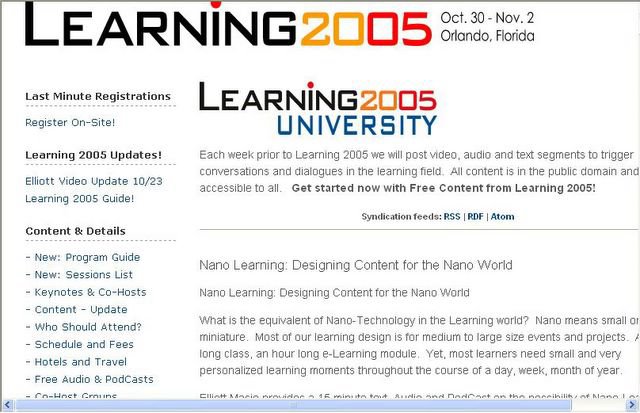
Learning University


Each week prior to Learning 2005 we will post video, audio and text segments to trigger conversations and dialogues in the learning field. All content is in the public domain and accessible to all. Get started now with Free Content from Learning 2005!
 Posted by Picasa

Saturday, September 24, 2005

learning environment

Many thanks for your email, Arnold. :-) I was hoping that some of the teachers in this group would jump in and asnwer your question... I'll give it a shot and please feel free to share your ideas and opinions:

I would like to quote a text from productive learning environment,
"What is a learning environment? A learning environment is all the influences that surround a learner and cause him or her to be interested in learning.

In order to help learners learn, one of our main tasks is to create a good learning environment."


And in creating a good learning environment, it has to to be productive so learners could be productive, too. This can be done in many ways. One is through seating arrangements. I think Mei has a lot of experience on this matter :-) In addition, the classroom has pictures, teachers tell stories, classmates are friendly, student sing songs, interesting information, a caring teacher, and a comfortable classroom that surrounds the students. In a productive enviroment, students are excited about learning. They like working with friends, asking questions, and playing games.

There are a few factors that we need to consider in creating a productive learning environment. They are:


physical conditions: Is the classroom too hot? Too cold? Too dark? Is it clean and tidy? Are there enough desks and seats? Are they safe?
¡Pclassroom layout: Is there a chalkboard? Does the teacher use good teaching aids? Do the learners have books and paper and pencils? Are they easy to reach and use?

roles and rules: Do the learners know how to answer questions? Do they know how to ask to leave the room? Do they know the rules when working with other learners?

learners' relationships: Are the learners fighting? Do they like their teacher?


I think many of the conflicts that arise in language schools are more related to factors 3 and 4, roles and rules, and learners' relationship.


The issue on teaching style that was discussed here has something to do with factor 4. The student simply did not like the teacher. This issue was also brought up a few months ago by April when she moved to a new school. The students were reluctant to have a new teacher. There were attitude problems, but I think all this have been resolved, right April?


Acccording to the learning environment program,

Learners' relations with the teacher could be improved when teachers show or exhibits the following behaviors:


the teacher should model caring behaviour: being gentle, smiling, asking questions, helping learners if they have trouble, asking learners to help other learners.
learners should feel free to ask the teacher questions.
learners should feel free to talk to the teacher outside of the classroom.
learners should feel free to touch or hug the teacher if they wish. (This varies from culture to culture.)


I would appreciate comments from the teachers in this group. Do you agree or disagree with any or points made above? Any opinions, suggestions, clarifications?


I look forward to hearing from you.


I've got to go and attend the conference at Wen Zao where I hope to meet Joy.


Cheers everyone!


aiden


arnold wrote:

Hmm. I think you've got many different implicit questions here (no doubt
related here and there). I'd like to have a closer look at teaching and
learning styles perhaps and the implications thereof.

Obviously different teachers teach differently, they have their own
different styles - much in the same way that students also differ in the
ways they learn (best) or think they learn (best). Where they necessarily
meet (in the classroom situation), how much tolerance and patience is there
among both parties to "deal" with these differences. On either side there
will always be a degree of "otherness from how one would like to see things
done oneself" that cannot be ironed out for the sake of a theoretically
perfect match. It is an illusion to think this could be done and a mistake
probably that it should be done.

I think neither the teacher nor the students should be scrutinized too
heavily on this point. Maybe we should concentrate more on the learning
environment instead.

The richer and varied the learning environment that teachers and students
create together is, the less important it is to give a lot of attention to
the notion of different teaching and learning styles. I think that teaching
or learning to (assumed) styles can be so intrusive that it may stunt the
development of the various other learning powers that are always latent in
every student.

Assuming there is some sense in the above assumptions and I would like you
to bear with me on this point, one key question to start with would be:

What are charactistics of such a language learning environment?

Wednesday, September 21, 2005

CEF conference in Kaohsiung


http://www.lttc.ntu.edu.tw/cambridge/CEF/CEFinvitation.htm CEF(Common European Framework of Reference for Languages: Learning, teaching, assessment)  Posted by Picasa

Thursday, August 11, 2005

Reflective teaching: Exploring our own classroom practice


Reflective teaching: Exploring our own classroom practice
Julie Tice, Teacher, Trainer, Writer, British Council Lisbon


Reflective teaching means looking at what you do in the classroom, thinking about why you do it, and thinking about if it works - a process of self-observation and self-evaluation. By collecting information about what goes on in our classroom, and by analysing and evaluating this information, we identify and explore our own practices and underlying beliefs. This may then lead to changes and improvements in our teaching.
 Posted by Picasa

Thursday, August 04, 2005

Scholar Google Search


Online search is getting better and better, not to mention- easier! Posted by Picasa

My Lesson Plan published in IATEFL Computer Special Interest Group


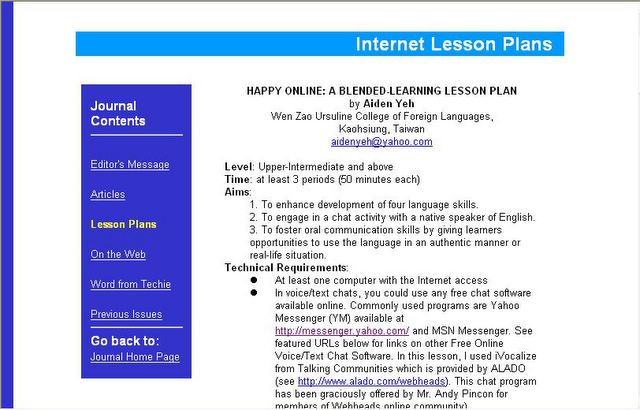
HAPPY ONLINE: A BLENDED-LEARNING LESSON PLAN

by Aiden Yeh

Wen Zao Ursuline College of Foreign Languages,

Kaohsiung, Taiwan
 Posted by Picasa

Wednesday, August 03, 2005

Who needs Education schools?


EDUCATION / EDUCATION LIFE | July 31, 2005
Teaching for Teachers: Who Needs Education Schools?
BY ANEMONA HARTOCOLLIS
What colleges teach. What teachers need to know. And why they're not the same. Posted by Picasa

Great Articles on Blogs


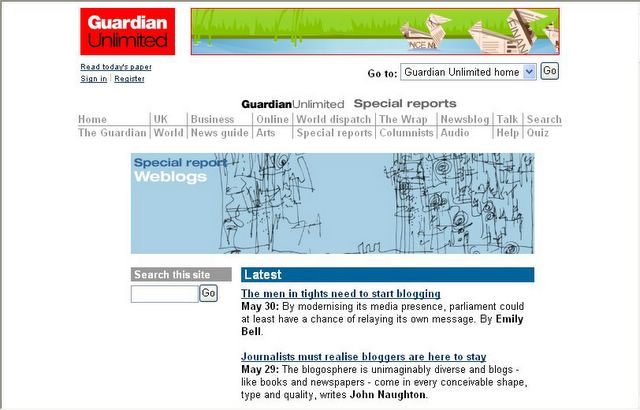
Special Report on Blogs, Guardian Unlimited Posted by Picasa

Saturday, June 25, 2005

Online discussion at Alado


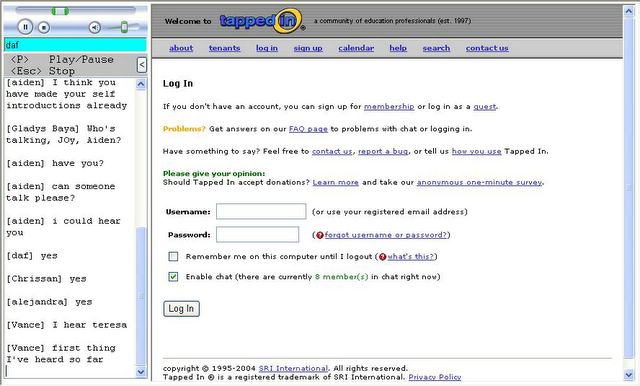
Online Discussion at Alado, June 25, 2005 Posted by Hello

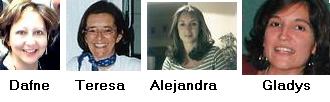
The online discussion started later than scheduled because of me. I had a technical problem: my mic wasn't working. I thought that it had something to do with some malfunctions on my keyboard. All the people present were very helpful, providing me suggestions on how I could make my mic work. But after working on it for 15-20 minutes, I just had to give it up because time was running out. Dafne offered to repeat or reading what I've written on the text board. It worked but it was a bit frustrating because I really wanted to be 'heard'. Nonetheless, the session went smoothly. Alejandra, Gladys, Dafne, Teresa, Chrissan all made wonderful contributions. Sus and Vance dropped by to say 'Hi' and this somehow made me feel relaxed and confident that everything would be alright. Why? Because webheads were there. Greta, a student of mine, also dropped by. She even managed to say a few words.

Here are the main points that were discussed during the session: pre-writing, picture description, email exchange, and blogs [which would integrate all other activities that were discussed]. There were many suggestions that were given and like what everybody else online said, it would take time to be able to practice everything that was discussed tonight. But what is important is that we were able to encourage Joy to start thinking about other activities that could make writing more fun for her students. We will just wait and see whether she'll use some if not all the things that were discussed tonight. Like any other meetings or conferences, the time is always not enough to discuss everything that we wanted to share. But we did, however, achieved the goals of this session.

This session was recorded and uploaded online, and it can be viewed at http://dcyeh.com/aiden_phd/session1.htm

The recording is still uploading as I write this, it is a huge file, afterall.

I hope that it gets uploaded, 'will let you know.

aiden

Happy birthday, Gladys!


Happy birthday, Gladys! Posted by Hello

Click play to hear the music.

Many thanks for spending a few hours of your special day with us, Webheads and Joy. We will never forget this event. Happy birthday once again and may you have many more to come!


Online Discussion on Teaching Writing to Young EFL Learners


Online guests for Aiden Yeh's online discussion on teaching writing to young EFL learners. This online session is part of Joy Chiu's teacher development training program.  Posted by Hello

What: Online chat
Time: 9:30 pm Taiwan time
Place: Alado, http://www.aladonet/webheads
Login: Type your name, No need for password, click 'enter'
Date: June 25, 2005, Saturday

Topic of discussion: Teaching writing to young learners
For: Buxiban teachers

Guests: Teresa Almeida D'Eca, Gladys Baya, Alejandra Weser, Prof. Dafne Gonzalez

Online Resources for Teachers of Young Language Learners [Reading and Writing], click here.

Friday, June 24, 2005

Attention: Mei

This message goes to Mei, who I find quite difficult to find :-( these days.

Mei, I saw your brief message on my tag board. Thanks for the message :-) I am not sure if you have changed your email address since you mentioned that you have not been receiving emails from me. Could you please let me know your new email address?

The group still meets at our YG, click here to go there.

Here's an update of what we've been doing lately and what we will be doing in the following weeks.

Joy Chiu [Fina] will be observing her Writing class at her new school, Garden, today, June 24, Friday. She will record her class. To do this, I lent her my videocamera which she will be returning in a week. Fina also be joining an online discussion with other foreign teachers who have various experiences in teaching writing to young EFL/ESL students. This online session is scheduled tomorrow, on Saturday at 9:30 pm Taiwan time. The place of the chat is at Alado, http://www.alado.net/webheads to go there, just click on the link above. Click on 'Log in', enter your name, NO need for password, and click 'Enter'

I hope that you could make it tomorrow.

You asked me if there's anything you could do for me. Well, my answer is YES, I'm asking a very big favor and I would be deeply indebted if you could help me on this one.

First, you will need to think of an area in your teaching that you would like to learn more, improve or enhanced. Fina chose 'teaching writing to young students', what about you? The area is not limited to learning skills but could we also explore classroom management, if you want.

Second, you will need to observe your class, record on video for observation purposes, then, we will ask the experts to contribute their knowledge and opinion about your query.

Third, observe your class again for the second time, this should be done after we talked to the experts.

If this isn't clear to you, please let me know and I'll explain it in detail.

I hope to hear from you, Mei.

Cheers,

Aiden

On sharing...

I visited NNEST Caucus's blog and I know that Lucie has been working real hard to keep the site going. In one of her rumblings ;-) she mentioned something about sharing and this has caught my eye. I've touched on that topic here on my blog and on our Taiwanese YG, and now it has resurfaced again, this time on an international caucus group.

I posted a comment and here's what I wrote:

Hi there,

Apologies for not being so active lately. I've been busy with school, wrapping things up- now that we're on our last week of school. But I still have to take care of grading a listening and speaking test for an admission test that we gave this week. Anyway, I read your message and this statement caught my attention, "Maybe not ideas about presentations, since we don't want other people to use our original ideas, write the same proposal, and compete against us." You know, Lucie, I think, this is the very culprit why people hesitate to 'share'. I also find this to be true among taiwanese teachers. Having said that, I am beginning to think that this is not a cultural thing. It happens everywhere and to all of us. It's part of being human. People are willing to share for as long as it they deem it safe and productive. However, people also tend to protect themselves and their personal interests, as well. Just like what you said about competing with each other. If you let your guards down, there is always that fear that others may take advantage of the situation [vulnerability or whatever that is].

aiden
p.s.
you're doing a good job Lucie, keep it up ;-)


This is something that I should keep in mind and should be mentioned in my thesis!!!

aiden

Friday, June 17, 2005

Trial session with Joy and webheads in Alado


Trial-Run with Joy, June 17, Friday, 15 GMT at Alado. Online discussion on teaching writing to young EFL learners is slated on June 25th Saturday, 13:30 GMT also at Alado http://www.alado.net/webheads Posted by Hello

Friday, June 10, 2005

in response to Alejendra [call for experts]

Many, many thanks Alejendra. I was thinking about my use of the word 'expert'; it sounds 'daunting', is it?

The online discussion is not intended to be a formal lecture. It's more like sharing about what you've been doing in your writing class, things that have worked with your students, and activities that are fun and stimulating. I have been out of the 'TEYL' (Teaching english to young learners' stream for a long time, and I think that I'm not doing quite a good job with my own children. It's difficult teaching your own children. In my case, I get too cranky. My expectations just shoots up and down. I'd rather hire a tutor to do formal lessons. My husband and I occassionaly speaks English to our children but this isn't enough. Miki (my husband) isn;t worried, though.

Anyway, I think Joy and I could learn a lot from your experience. I'll let you know when the fixed date is, ok?

Thanks!

Hugs,

aiden
p.s.

I'm also collecting URL links to teachers' online resources on teaching writing to kids. If you know of any, I'd appreciate if you could pass them along. :-)

aleweser wrote:
Dear Aiden and Joy,
I have classes every other Saturday, but if I happen to be at home on
the day you plan your webcast you can count on me to share my
experience. Not that I consider myself the expert you are looking for
but I have been teaching 6th graders (11-year-olds) for over twenty
years now so I might have a few ideas to share and I have no doubts
there will be a lot more I can learn from you.

I really look forward to hearing from you.

Alejandra Weser

call for experts on teaching writing to young efl learners

Dear Webheads,


As some of you may know, I’m doing my post grad studies on Taiwanese teachers’ professional development. I am now on the 2nd stage of my research. I have three Taiwanese EFL teachers teaching at supplementary schools (cram schools) who have agreed to take part in my research. Two have created blogs to help them reflect on their teaching and things that they want to learn. We are now about to go to the observation phase. This phase is divided into two stages, before and after the online discussion/lecture/sharing (I still don’t know what to call it). Joy (one of the teachers who agreed to participate in my study) will have to document her teaching, in particular, how she teaches writing (her choice). She will then join an online discussion where my invited ‘expert’ will talk about/share some tips and fun activities that could motivate students.


Joy works Mon-Sat (am) and is willing to devote Saturday evenings (anytime from 13-15 GMT – an hour to an hour and a half) for special online discussions where she could learn something invaluable and something that she could do in her own classroom.


My dilemma is I need an expert on this topic, teaching writing to young learners. You do not have to be a teacher trainer, but you must at least know and have experienced teaching writing to young students. If you know some successful writing activities that you would like to share with Joy, then I also encourage you to join us.


This online discussion/sharing will not only be part of my study but most importantly, part of Joy’s professional development. Many Taiwanese EFL teachers in private language institutions share the same fate that Joy is experiencing: lack of teacher training support from the government and from the school that she works for. TPD for these teachers are considered to be unimportant because they are after all, what many locals consider ‘just a language school teacher’. Compared to Elementary school/high school/college English teachers, they are not really recognized as ‘teachers’. However, this does not mean that they are not good enough. I know some language school teachers whose English proficiency is far better that junior college teachers. I believe that with the right support and encouragement, these motivated teachers could experience the personal satisfaction of engaging in TPD. Joy has created her blog where she posts her thoughts and opinions about things that she’s learned in f2f conferences. She has attended 3-4 local conferences, and in one of these conferences, she was the only language school teacher who attended- the rest where college/university teachers. She was not intimidated by this, as a matter of fact, she was very active, participated in the session, and even raised some questions. Other teachers who were present were not as active as she was.


You may say that she’s different. But what makes her different is her tenacity to learn and improve herself (like Webheads)- all this without financial remunerations or the constant prodding of an employer or teacher. I think that she’s not at all different from the rest of us.


If you are interested in sharing your knowledge and skills with Joy, and if you are willing to spend an hour (or perhaps an hour and half) discussing some fun activities on teaching writing for young EFL students, then please, join us.


There is no fixed date yet, but it’s going to be a Saturday, 13-15 GMT, probably Alado or Learning times.


Many thanks in advance and I hope to hear from some of you.


Cheers,


Aiden Yeh

teaching writing [response to Joy]

Many, many thanks for your email. It's certainly nice to hear from you. So, you've finally accepted the job offer from Garden. That's good news. How is it?

With regards to your topic, I think that it is very interesting. I'll line up some topics and will get in touch with lecturers. Saturday night is cool.

I'll keep you updated.

aiden

Chiu Joy wrote:
Dear Aiden,

Sat nights are fine. Just let me know which day.
And because I've just started my only new class at Garden
this week, I need a little time to set up the class.
The observation will take place once before and once after
the online lecture, right?

So as soon as you lend me the equiment (let's say,
sometime between mid June and the begining of July),
I should be able to record the first part.

As to the second time, maybe you can come in if
you like. Or I can tape it, but first we need to schedule
a date for the on-line lecture. The topic I want to discuss:
ways/methods/games/activities that help Ss learn how to write.

I guess I need to be more specific, but I don't have a clear
idea myself yet. Will let you know later.

Look forward to the online lecture already!!!
Talk to you soon.

PS. I've got so many wonderful experience with Garden.
But don't have time to put them on my Blog yet.
Hopefully, I can have that done this weekend!!!


Fina aka Joy

Need help badly

Hello guys,

This is an urgent call- a very, very urgent call for help ;-)

I need to start doing my observation, and as you know, time is running out. I know you have been very busy with your careers, some of you may be starting new ones, some of you, maintaining and rejuvenating your jobs. Likewise, I have been very busy too and I'll be starting online courses this summer, not to mention, my f2f (face-to-face- classes in Wen Zao). Your blogs (Mei and Fina) have been very successful and I would like to congratulate you on that. Not many teachers, even in higher education, have the willingness and tenacity that you guys have. April? When are you going to start your own?

The messages that you've posted on our taiwanese-efl-yahoogroups have been very helpful and the reflective approaches have somehow influenced your professional development. I hope that you all will continue on what you have started.

Now, back to the purpose of this letter ;-)

I want us all to participate in a more active stance of your tpd (teacher professional development). I really wanted you to engage in an online lecture to be conducted by one of my invited foreign guest lecturers. I've got so many volunteers. I asked you one time about the time and date of your availability and many of you wrote Saturday, evening, so I am looking at Saturday evening from 8-11 pm. The session won't last that long but will go on for an hour or an hour and a half. This is what I want you to do (you must do!)

1. Think of a topic that you would like to learn more. This must be classroom oriented i.e. teaching reading, teaching spelling, teaching grammar, or even classroom management. The topics may vary and the topics may be divided into 2-3 online sessions. We could line them up.

2. Based on what you will be learning online, you will then practice or adapt in your classroom the things that you learned from the online sessions. This will be observed by me or via video (which I could lend you for observation purposes).

Are you ready for this?

If you don't have computers at home, please let me know so I could arrange for us to meet at home and we'll have a blended learning session (I'll provide the computer, internet and webcam so we could meet our online guests).

Are you with me so far?

If you're experiencing any difficulties with my requests, I would appreciate if you could let me know ahead of time.

Many, many thanks and I look forward to hearing from you.

Aiden