I'm quoting a colleague and friend here, Vance Stevens, he wrote: "scaffolding is the term constructionists use to describe the bootstrapping that takes place between those interacting within a ZPD or zone of proximal development. The theory is that learning is social and that people learn from one another by feeding off each other's expertise ('scaffolding'), as we do in Webheads."
Well said...
aiden
Thursday, April 28, 2005

Wednesday, April 20, 2005
David Nunan's Workshop: Motivating Young Learners

David Nunan talked about the 7 principles of motivation:
1. Make learning goals explicit. Share the goals to students, make students aware fo them to become motivated. What goals are and how to achieve goals.
2. Select content that learners can relate to.
3. Scaffold the learning process.
4. Provide the opportunites for personalization. Provide students the chance to invest on their learning.
5. Encourage group cohesion.
6. provide opportunities for genuine communication
7. provide learners evidence of progress
Fina also attended this conference, and according to her, out of the 3 workshops that were offered, she felt that Susan Stempleski's workshop was more engaging. Unfortunately, I missed Susan's session. I arrived just in time for David's workshop.
I also had a chance to talk to him about the workshop on distance learning that he's going to conduct sometime July in the U.S.
aiden
Saturday, April 16, 2005
Visiting English Garden
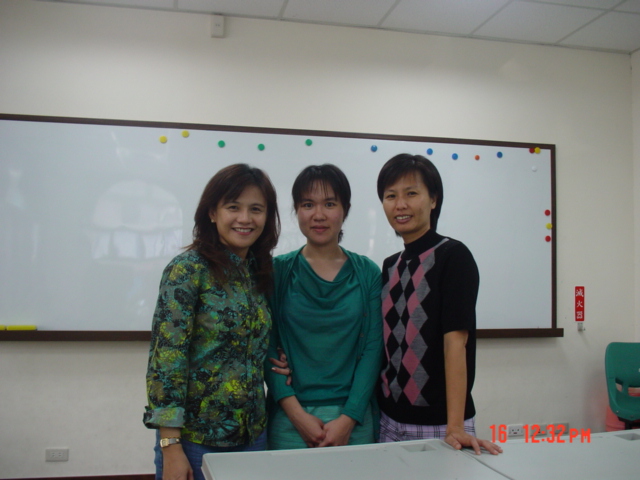
Seen in this photo is Me (far left), April and her employer (far right). Taken in the same classroom, it can be seen on my face how pleased and happy I was. I hope that this wouldn't be the last time because English Garden is a place that exudes a garden of possibilities.

April and her employer

A lovely picture taken today, April 16, 2005, at April's school. April (lady in green) is seen here with her employer, a very admirable lady, who believes in good teaching and learning. This classroom is on the first floor (or ground floor), and the glass panels make the room bright and conducive for learning. The chairs are comfortable and the tables used are similar to the ones we are using in Wen Zao. The green paint on the walls and beams makes the room livelier- it gives the room a 'fresh' look. The room has a very nice layout- far from the typical cram school or language school setting- small and narrow. I'm very pleased that I've decided to visit April today. It was worth it.
Friday, April 15, 2005
Native speaker teachers
From the British Council, interesting comments regarding Native and Non-Native teacher dichotomy.
Native speaker teachers
"Are native speaker teachers automatically the best teachers of a language? Just because you speak a language naturally, does that mean you can teach it? Or does the process of learning a language to a high level of fluency make non-native speaker teachers far better equipped to teach that language?"
To view results, click here:
Native speaker teachers
"Are native speaker teachers automatically the best teachers of a language? Just because you speak a language naturally, does that mean you can teach it? Or does the process of learning a language to a high level of fluency make non-native speaker teachers far better equipped to teach that language?"
To view results, click here:
Thinking frames
Thinking frames
Mario Rinvolucri, Pilgrims, UK
In this article I want to share with you a major thinking frame, that has been of great use to me in my teaching and that comes from the work of Antoine de la Garanderie, a major French pedagogical thinker.
Read full article here.
Mario Rinvolucri, Pilgrims, UK
In this article I want to share with you a major thinking frame, that has been of great use to me in my teaching and that comes from the work of Antoine de la Garanderie, a major French pedagogical thinker.
Read full article here.
Some thoughts to ponder...
This thread of messages was passed on from NNEST Caucus list-serv which I am putting here to remind me of things and issues to consider when I start writing my paper (God knows when...)
-------------------------
I agree that Language Proficiency of NNESTs is an important issue to be considered. There are several related issues we can examine. One idea is to explore further the strategies that teachers can use most effectively with the level of language proficiency they currently have. The other is intervention and language training as part of our teacher education programs, which can be a longitudinal study with having control groups, and the most important of all is the relationship between language proficiency and teaching as Ahmar has brought up. Some very interesting ideas were presented in the TIRF research colloquium that Lia organized. Issues examined by TIRF researchers can be looked at and researched from a more global context including countries in Asia, Middle East, and Europe.
Best,
(name has been removed)
-----------------------------------
Thank you for raising this question about teachers' language proficiency. It is one of great importance and relevance to the caucus and is only now beginning to be explored with academic vigor. In addition to the colloquium that you mentioned, concerns about language proficiency were also raised in the TIRF research colloquium that Lia organized, and in Zohreh Eslami-Rasekh's colloquium. The colloquium on World Englishes and TESOL also discussed similar concerns. While some initial thoughts were shared at this year's convention, this is definitely an issue that needs further work. The fundamental questions that we all need to ask is:
- What, if any, is the relationship between language proficiency and teaching?
And when we raise this question, we need to be willing to explore all possible options/answers - even those that some of us may not like.
(name of sender has been removed)
------------------------
Dear NNEST-Lers,
One suggestion for a research topic that might make a good colloquium theme was actually suggested by Juliam Edge as we prepared for our colloquium with him, Dilin Liu, Ahmar and myself: research into ways that NNESTs can learn how to do the most with the proficiency that they have. I know that Ahmar has some thoughts on some ideas. Such a topic could be of real interest and perhaps be a genuine benefit to those NNESTs teaching throughout the world who have not had the educational access that some of us have had.
(name of sender has been removed)
-------------------------
I agree that Language Proficiency of NNESTs is an important issue to be considered. There are several related issues we can examine. One idea is to explore further the strategies that teachers can use most effectively with the level of language proficiency they currently have. The other is intervention and language training as part of our teacher education programs, which can be a longitudinal study with having control groups, and the most important of all is the relationship between language proficiency and teaching as Ahmar has brought up. Some very interesting ideas were presented in the TIRF research colloquium that Lia organized. Issues examined by TIRF researchers can be looked at and researched from a more global context including countries in Asia, Middle East, and Europe.
Best,
(name has been removed)
-----------------------------------
Thank you for raising this question about teachers' language proficiency. It is one of great importance and relevance to the caucus and is only now beginning to be explored with academic vigor. In addition to the colloquium that you mentioned, concerns about language proficiency were also raised in the TIRF research colloquium that Lia organized, and in Zohreh Eslami-Rasekh's colloquium. The colloquium on World Englishes and TESOL also discussed similar concerns. While some initial thoughts were shared at this year's convention, this is definitely an issue that needs further work. The fundamental questions that we all need to ask is:
- What, if any, is the relationship between language proficiency and teaching?
And when we raise this question, we need to be willing to explore all possible options/answers - even those that some of us may not like.
(name of sender has been removed)
------------------------
Dear NNEST-Lers,
One suggestion for a research topic that might make a good colloquium theme was actually suggested by Juliam Edge as we prepared for our colloquium with him, Dilin Liu, Ahmar and myself: research into ways that NNESTs can learn how to do the most with the proficiency that they have. I know that Ahmar has some thoughts on some ideas. Such a topic could be of real interest and perhaps be a genuine benefit to those NNESTs teaching throughout the world who have not had the educational access that some of us have had.
(name of sender has been removed)
Tuesday, April 12, 2005
Meeting April for the second time
Below is a message from April:
Dear Aiden:
My employer told me she is willing to meet you this coming
Saturday or Sunday.( She prefers Saturday morning if it is possible!)
You can also see our cram school" Garden English School". That is a
six floors building. From the first to third floors are the classrooms
and office and my employer is living in the sixth floor. We welcome
you to come and see a high quality and wonderful environment to learn
English. The address is :(Omitted)It only
takes 10 minutes from your husband's hospital to our cram school.If
you have any question, you can call (Omitted) It's so happy
to see you soon!!
Dear Aiden:
My employer told me she is willing to meet you this coming
Saturday or Sunday.( She prefers Saturday morning if it is possible!)
You can also see our cram school" Garden English School". That is a
six floors building. From the first to third floors are the classrooms
and office and my employer is living in the sixth floor. We welcome
you to come and see a high quality and wonderful environment to learn
English. The address is :(Omitted)It only
takes 10 minutes from your husband's hospital to our cram school.If
you have any question, you can call (Omitted) It's so happy
to see you soon!!
Monday, April 11, 2005
Free Thomson Training
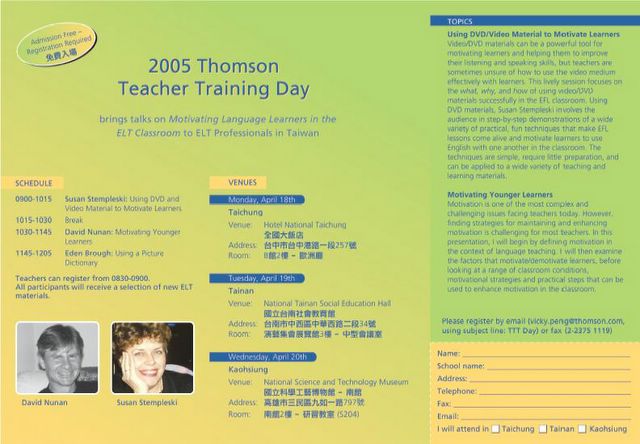
David Nunan and Susan Stempleski Free Training Sessions sponsored by Thomson.
Message from Thomson:
Dear Teaching Professional,
This year we are very happy to offer presentations for English teaching
professional in Taiwan. We feature presentations by two of the most
prominent names in the field of ELT - David Nunan and Susan Stempleski - who
also happen to be past presidents of TESOL International.
Please see the e-file of invitation card as attached. Shall you need more
details please do not hesitate to contact with me directly.
Sincerely yours,
Vicky Peng
Marketing Coordinator
Thomson Learning
Sunday, April 10, 2005
Answers to April's ideas
This is in response to April's message to Taiwanese EFL teachers yahoogroup:
I would like to focus first on the last two because I believe if we could bring about change in ourselves as teachers then this group [taiwanese-efl-teachers yahoogroup] has already achieved its purpose. I also hope that in the future there will be more taiwanese teachers in cram schools who'll be joining this group. For those who are already here I hope that you've already learned a thing or two and that you'll stay to continue on learning.
April wrote: 3.Should the experienced teacher train the new teacher?--I know most of the teachers don't want to share their teaching mothod with the new teacher beacuse they think if I teach you how to teach the kids, maybe I will be replaced some day. I don't want to share the experience with anybody because "that" is my tool to survive in the area(at the cram school). I think those problems are happening to me in the past one month. I am still learning and I often question myself how to be a good teacher?
-------------------
I believe that this boils down to teacher's attitude, her willingness to share and cooperate with colleagues. Protecting one's own interest is human nature and we can't force people to do something that they don't feel like doing. Let us take this group for example, many of the teachers here are Taiwanese teachers, not all contribute to the discussions. Many are receiving messages, perhaps they read them and delete them afterwards. Are they learning something? Well I hope so! Are they sharing something to the group? Some- yes, some- may be in the future. Do some of you here feel that once you share your ideas- you'll lose your jobs? Not really- since we don't work in the same school. but, do you sometimes refuse to share what you know for personal reasons? Have you ever experienced feeling insecure about losing your job hence you keep that trade-secret [good teaching] all to yourself? You may or may not post your answers but I want you to keep these questions in mind.
Should the experienced teacher pass on her knowledge to other teachers? Should she? My answer is pretty simple: if she's paid to train you, then she doesn't have a choice but to do so. That's part of her job. What kind of a teacher trainer would she be if she refused to share and pass on what she knows?
If you're talking about a co-teacher whom you find a little 'protective' of her own interest, then I say, we can't blame her. That's the way she is and so just let her be. Mind our own business, and do something that is productive. Teachers who find it difficult to collaborate usually do not have many friends and more often than not find it difficult getting along with people. In any oragnization, interpersonal skills are very important. If I were an employer I would want my employees to work well together, to form a unit that is focused on achieving our organization's goals. Teachers who refuse to work together harmoniously make a manager's job difficult. It's either you retrain her or fire her. but as a teacher who works in the same environment I say focus instead in improving yourself. Let the boss decide on her fate.
A teacher who keeps on learning, updating her self with new skills and learning and applying teaching methods tends to keep the job. If you feel that you are armed with good teaching skills and interpersonal skills then you will never feel insecure of losing your job.
As an English teacher in cram schools, you may soemtimes deal with criticisms [parents, co-teachers, etc]. How do you deal with them?
How do you become a good teacher? How would you describe a good teacher? Perhaps, Elizabeth and Arnold could share their insights on this topic.
Cheers and have a nice weekend.
I'm off to church then to a bridal shower later this evening,
Aiden
I would like to focus first on the last two because I believe if we could bring about change in ourselves as teachers then this group [taiwanese-efl-teachers yahoogroup] has already achieved its purpose. I also hope that in the future there will be more taiwanese teachers in cram schools who'll be joining this group. For those who are already here I hope that you've already learned a thing or two and that you'll stay to continue on learning.
April wrote: 3.Should the experienced teacher train the new teacher?--I know most of the teachers don't want to share their teaching mothod with the new teacher beacuse they think if I teach you how to teach the kids, maybe I will be replaced some day. I don't want to share the experience with anybody because "that" is my tool to survive in the area(at the cram school). I think those problems are happening to me in the past one month. I am still learning and I often question myself how to be a good teacher?
-------------------
I believe that this boils down to teacher's attitude, her willingness to share and cooperate with colleagues. Protecting one's own interest is human nature and we can't force people to do something that they don't feel like doing. Let us take this group for example, many of the teachers here are Taiwanese teachers, not all contribute to the discussions. Many are receiving messages, perhaps they read them and delete them afterwards. Are they learning something? Well I hope so! Are they sharing something to the group? Some- yes, some- may be in the future. Do some of you here feel that once you share your ideas- you'll lose your jobs? Not really- since we don't work in the same school. but, do you sometimes refuse to share what you know for personal reasons? Have you ever experienced feeling insecure about losing your job hence you keep that trade-secret [good teaching] all to yourself? You may or may not post your answers but I want you to keep these questions in mind.
Should the experienced teacher pass on her knowledge to other teachers? Should she? My answer is pretty simple: if she's paid to train you, then she doesn't have a choice but to do so. That's part of her job. What kind of a teacher trainer would she be if she refused to share and pass on what she knows?
If you're talking about a co-teacher whom you find a little 'protective' of her own interest, then I say, we can't blame her. That's the way she is and so just let her be. Mind our own business, and do something that is productive. Teachers who find it difficult to collaborate usually do not have many friends and more often than not find it difficult getting along with people. In any oragnization, interpersonal skills are very important. If I were an employer I would want my employees to work well together, to form a unit that is focused on achieving our organization's goals. Teachers who refuse to work together harmoniously make a manager's job difficult. It's either you retrain her or fire her. but as a teacher who works in the same environment I say focus instead in improving yourself. Let the boss decide on her fate.
A teacher who keeps on learning, updating her self with new skills and learning and applying teaching methods tends to keep the job. If you feel that you are armed with good teaching skills and interpersonal skills then you will never feel insecure of losing your job.
As an English teacher in cram schools, you may soemtimes deal with criticisms [parents, co-teachers, etc]. How do you deal with them?
How do you become a good teacher? How would you describe a good teacher? Perhaps, Elizabeth and Arnold could share their insights on this topic.
Cheers and have a nice weekend.
I'm off to church then to a bridal shower later this evening,
Aiden
Thursday, April 07, 2005
When Two Vowels Go Walking

When Two Vowels Go Walking
When two vowels go walking
The first one does the talking
In "boat" you hear the "o" and not the "a"
In "meat" you hear the "e"
The "a" sits quietly
The second vowel you see but you don't say
But...
Shh!
Just the two of us together
In "train" and "pail" and "rain"
The "a" speaks up; the "i" does not
But...
Shh! Let me explain
When two vowels go walking
The first one does the talking
In "brain" you hear the "a" but not the "i"
In "soap" the "o" is clear
The "a" you never hear
In "say" you say the "a" and not the "y"
But...
Shh! Isn't it neat?
But...
Shh! It can't be beat!
But...
Shh! It's such a dream!
Don't mean to boast
But here's a toast
We're quite a team!
When two vowels go walking
The first one does the talking
I'm sorry, number two, it's such a shame
Although it gives you pain
The rule is very plain
When two vowels walk
The first one says its name!
But...
Shh!
Yes, when two vowels walk
The first one says its name!
The Taipei English Language Teaching Conference (TELTC) April 2005
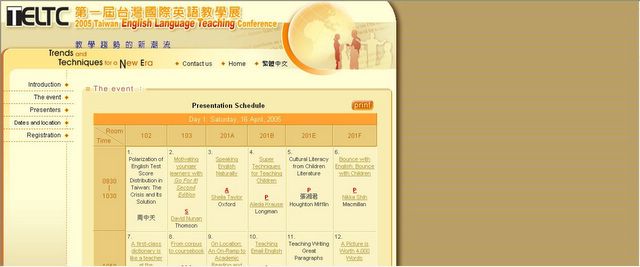
TELTC aims to merge modern practices in Taiwan English Language Teaching with global research into current ELT trends. At its inaugural conference in April 2005, TELTC offers a carefully planned program of presentations conducted by internationally renowned ELT scholars and practitioners. There will also be a comprehensive book exhibition showcasing new ELT publications.
Wednesday, March 23, 2005
Fina's Blog- flying high

Fina's blog has evolved. She had turned it to what it's supposed to be. she's using it for her TPD, posting reflective comments adds depth and character, but I think, it's when she reflects on things and events in her teaching that learning and development takes place. I'm proud of her. I hope there will be many other Finas out there waiting for their talents to be tapped and passion for learning to flourish.
April's ideas
April responded to my previous email and she has outlined three important things that she would like to explore in her working/teaching environment. And this is what I sent her:
April,
This is good. Can you post this to our yahoogroup, Taiwanese yahoogroups and perhaps our invited teacher trainers, Arnold and elizabeth will share their ideas and opinions.
The topic, "How do kids really learn?" is quite broad. Maybe we could be specific about it. Learning- which skill are we talking about? There should also be a criteria or performance rubric to see how the students' ability have improved. For example, in reading, you could give a new reading material and ask the students to read it. See how many they know or don't know. Do it for a week or two and check again. See how many words have been learned and retained. If you put your observation in a table it would be easier to see the improvements. Which language skills are you interested in? Let me know and I'll give you a list of activities that could help you in your class.
Cheers.
Aiden
april wrote:
Dearest Aiden: Hi! How are you today? I think about some issue are related to teaching such as 1.how to communite with the parents-- I know most of the parents are too busy so they don't know how the English teacher teaches their childern and what do the kids learn, how much do they really leaen at the cram school? Some parents think they pay the money and the English teacher should take the whole responsobility for teaching.I mean if the kids don't learn English well, it would be the teacher's problem.2. How to have a good relationship with your coworker?3.Sholud the experienced teacher train the new teacher?--I know most of the teachers don't want to share their teaching mothod with the new teacher beacuse they think if I teach you how to teach the kids, maybe I will be replaced some day. I don't want to share the experience with anybody because "that" is my tool to survive in the area(at the cram school). I think those problems are happening to me in the past one month. I am still learning and I often question myself how to be a good teacher?
April,
This is good. Can you post this to our yahoogroup, Taiwanese yahoogroups and perhaps our invited teacher trainers, Arnold and elizabeth will share their ideas and opinions.
The topic, "How do kids really learn?" is quite broad. Maybe we could be specific about it. Learning- which skill are we talking about? There should also be a criteria or performance rubric to see how the students' ability have improved. For example, in reading, you could give a new reading material and ask the students to read it. See how many they know or don't know. Do it for a week or two and check again. See how many words have been learned and retained. If you put your observation in a table it would be easier to see the improvements. Which language skills are you interested in? Let me know and I'll give you a list of activities that could help you in your class.
Cheers.
Aiden
april wrote:
Dearest Aiden: Hi! How are you today? I think about some issue are related to teaching such as 1.how to communite with the parents-- I know most of the parents are too busy so they don't know how the English teacher teaches their childern and what do the kids learn, how much do they really leaen at the cram school? Some parents think they pay the money and the English teacher should take the whole responsobility for teaching.I mean if the kids don't learn English well, it would be the teacher's problem.2. How to have a good relationship with your coworker?3.Sholud the experienced teacher train the new teacher?--I know most of the teachers don't want to share their teaching mothod with the new teacher beacuse they think if I teach you how to teach the kids, maybe I will be replaced some day. I don't want to share the experience with anybody because "that" is my tool to survive in the area(at the cram school). I think those problems are happening to me in the past one month. I am still learning and I often question myself how to be a good teacher?
Meeting April's Employer
I received an email from April about a week ago but was too busy with school work that it got burried in my piles of unread messages. I had a chance to clean up my mail box the other day and responded to messages that badly needed attention. April's message was very encouraging, yes, at a time when I don't see the importance of continuing my studies. Depression hits hard. Anyways, I told April that I would love to meet her employer. I've heard good words about her, so I think it's about time to meet her in person. However, I told April that I'd like to do that and perhaps observe her class, too. She agreed. I think that trust has been established- and I think that April knows that other than the fact that I want to earn my degree, deep in my heart, I want to help- those who want to improve their teaching and most importantly- themselves. I think with April and Joy [Fina] I think I've accomplished my goal. Success here is intrinsic- but so powerful and I find it difficult to describe it- perhaps in due time.
Aiden
Aiden
Tuesday, February 22, 2005
Foreign teachers and teacher trainers to join Taiwanese YG
The recent requests of colleagues from different countries to join in my Taiwanese Yahoogroup have sparked a new sense of hope and motivation, and renewed faith that what I'm doing is worth the pain and sacrifices. I'm noting here what they've sent me:
From Michael B.:
Comment from user:
I am very interested in how bu-shi-ban teachers
can better both their careers and their teaching with or without encouragement
and help from those in a position of control.
From Arnold M. [I invited Arnold because my group and I could learn a lot from him.]
Comment from user:
Hi Aiden, I will gladly accept your invitation to this Yahoo group. TPD has
always had my interest and reflective practice is close to my heart. Cheers,
Arnold
From Elizabeth H-S:
Also--anything I can do for you with the TPD YG? I am really interested in your project and hope to start something like this in the future.
Cheers--
--Elizabeth
------------------
Now, I think my plan is working. I've got to clear out the road and start walking.
/aiden
From Michael B.:
Comment from user:
I am very interested in how bu-shi-ban teachers
can better both their careers and their teaching with or without encouragement
and help from those in a position of control.
From Arnold M. [I invited Arnold because my group and I could learn a lot from him.]
Comment from user:
Hi Aiden, I will gladly accept your invitation to this Yahoo group. TPD has
always had my interest and reflective practice is close to my heart. Cheers,
Arnold
From Elizabeth H-S:
Also--anything I can do for you with the TPD YG? I am really interested in your project and hope to start something like this in the future.
Cheers--
--Elizabeth
------------------
Now, I think my plan is working. I've got to clear out the road and start walking.
/aiden
Monday, February 21, 2005
In response to Arnold Muhren's comment on TPD
Hi Arnold,
many thanks for posting a comment on my blog. I'm forwarding your message to my Taiwanese yahoogroups because I think the teachers in that group could learn something from your message.
I agree with what you said:
"1) The reflective student teacher may have a "master teacher" around for mentoring, coaching and surely some modelling as well.
2) The reflective student will want to find clarification and support for their own hypotheses, theories, intuitions, actions, behaviour, hunches, etc. in the literature or in discussions with more experienced colleagues"
I am hoping that what I'm doing would somehow influence these teachers to become reflective teachers and like what michael butler mentioned in his email when he joined the group that he wanted to see how they become better teachers without their employer telling them. Me too. Taiwanese teachers in cram schools deserve to learn more not only teaching methodologies but how to reflect on their teaching as well.
I invite you to join this group and feel free to toss in your two euros!
http://groups.yahoo.com/group/taiwanese_efl_teachers/
/aiden
many thanks for posting a comment on my blog. I'm forwarding your message to my Taiwanese yahoogroups because I think the teachers in that group could learn something from your message.
I agree with what you said:
"1) The reflective student teacher may have a "master teacher" around for mentoring, coaching and surely some modelling as well.
2) The reflective student will want to find clarification and support for their own hypotheses, theories, intuitions, actions, behaviour, hunches, etc. in the literature or in discussions with more experienced colleagues"
I am hoping that what I'm doing would somehow influence these teachers to become reflective teachers and like what michael butler mentioned in his email when he joined the group that he wanted to see how they become better teachers without their employer telling them. Me too. Taiwanese teachers in cram schools deserve to learn more not only teaching methodologies but how to reflect on their teaching as well.
I invite you to join this group and feel free to toss in your two euros!
http://groups.yahoo.com/group/taiwanese_efl_teachers/
/aiden
Discovering your own teaching style
Hi April,
From what I could gather from your emial below, your ex-colleague got fired. She did not resign. She got fired. Why do you think your employer fired her? Why do employers fire employees? She must have done something that irked your boss. If she's good, your boss would not have let her go. Simple.
Fast teaching? Is it a strategy? Is your boss referring to the pacing of your lesson, or pacing of your presentation [or how you teach in class]? Or how fast you speak?
In my opinion, every teacher is different. You're different- perhaps better than your ex-colleague. To compare yourself to somebody who got fired is not a good start to develop confidence. You teach in a way that your students learn. Look at their language needs- focus on them and develop a strategy that addresses these needs. Your school has its own working atmosphere, you follow the working regulations and report to work on time. But when it comes to students, you could always suggest. now there's a technique to this. You say it in a nice way, like you're doing your boss a favor, more like confiding, telling him/her what you think then ask for his/her opinion.
Another point that I wish to stress is that, I think your boss wants you to be able to gain your students' interest. Make it a fun learning experience for them. now it's not all about games, but how you arrange your activities.
I hope this helps.
/aiden
p.s.
any chance on putting up your blog, April. This is an interesting thread that you brought up here. You could continue on reflecting on this on your blog. Are you available Saturday evenings, say 9-10 pm for online discussions?
April wrote:
I am teaching one class in my cream school now. The students are
about 2~3 grade students who have been learning English for 2 years.
Because their first teacher who has 10 years experience was fired by
my boss so I replace her position. I have pressure when I teach
English because the students get used to their first teacher's style
already(very fast teaching style). Including my boss,they think the
tempo of teaching English should be as fast as possible.Do you agree
or not? They think when teacher's tempo of teaching is fast, the
students can pay much attention to the class and also they can learn
more .....Should I be like her or just be myself?
From what I could gather from your emial below, your ex-colleague got fired. She did not resign. She got fired. Why do you think your employer fired her? Why do employers fire employees? She must have done something that irked your boss. If she's good, your boss would not have let her go. Simple.
Fast teaching? Is it a strategy? Is your boss referring to the pacing of your lesson, or pacing of your presentation [or how you teach in class]? Or how fast you speak?
In my opinion, every teacher is different. You're different- perhaps better than your ex-colleague. To compare yourself to somebody who got fired is not a good start to develop confidence. You teach in a way that your students learn. Look at their language needs- focus on them and develop a strategy that addresses these needs. Your school has its own working atmosphere, you follow the working regulations and report to work on time. But when it comes to students, you could always suggest. now there's a technique to this. You say it in a nice way, like you're doing your boss a favor, more like confiding, telling him/her what you think then ask for his/her opinion.
Another point that I wish to stress is that, I think your boss wants you to be able to gain your students' interest. Make it a fun learning experience for them. now it's not all about games, but how you arrange your activities.
I hope this helps.
/aiden
p.s.
any chance on putting up your blog, April. This is an interesting thread that you brought up here. You could continue on reflecting on this on your blog. Are you available Saturday evenings, say 9-10 pm for online discussions?
April
I am teaching one class in my cream school now. The students are
about 2~3 grade students who have been learning English for 2 years.
Because their first teacher who has 10 years experience was fired by
my boss so I replace her position. I have pressure when I teach
English because the students get used to their first teacher's style
already(very fast teaching style). Including my boss,they think the
tempo of teaching English should be as fast as possible.Do you agree
or not? They think when teacher's tempo of teaching is fast, the
students can pay much attention to the class and also they can learn
more .....Should I be like her or just be myself?
Tuesday, February 15, 2005
Mei's answers to buxiban teachers on tpd
I always ask myself these questions. I like kids. I really want them
to feel happy in learning English. I am glad to know my cram school
has the same thought with me. :)
But there are some unbreakable concepts in Chinese society. For
example: Parents always want to see their kids get higher grade
instead of knowing how much or how better their kids learn.
Especially in town. City parents are more educated than town
parents. I don't mean to offend anyone, I just make a comment out of
personal feeling. I used to teach in the city cram school, now I
teach in town. Are we changed when we become parents? We want our
kids to get the best, so we forget we used to be young, to be judged
by the grades?
Being the teacher, I totally agree what the author said. We have to
have the right will to move on. That will be the best to our next
generation!! ^^"
PS: Sorry for typing too much...... >"<
to feel happy in learning English. I am glad to know my cram school
has the same thought with me. :)
But there are some unbreakable concepts in Chinese society. For
example: Parents always want to see their kids get higher grade
instead of knowing how much or how better their kids learn.
Especially in town. City parents are more educated than town
parents. I don't mean to offend anyone, I just make a comment out of
personal feeling. I used to teach in the city cram school, now I
teach in town. Are we changed when we become parents? We want our
kids to get the best, so we forget we used to be young, to be judged
by the grades?
Being the teacher, I totally agree what the author said. We have to
have the right will to move on. That will be the best to our next
generation!! ^^"
PS: Sorry for typing too much...... >"<
Monday, February 14, 2005
Applying the benefits of blogs on TPD
According to Brock, Yu and Wong, 1992 in Richards and Lockhart, 1996, 'keeping a journal can also be beneficial when one or more colleagues share their journals and meet regularly to discuss them.' Since your blogs are available online, we don't have to meet face-to-face to discuss what's on your blog.
In blogger, you are allowed to comment on somebody else's blog.
It is in this spirit of collaboration that I ask you to leave a comment on your colleagues's blog. I suggest that you do this regularly, as in once a week, so we could learn more from each other.
I should note, however, that we should practice professionalism in the midst of camaraderie. All comments that will be made must be taken in the light of constructive criticism. We comment on the topic and the issues being addressed and not on the person making the comment nor the person who wrote the topic that we wish to comment on.
To also foster reflective writing on your blogs, I will ask other teachers [mostly foreign teachers living abroad] to comment on your blogs] to generate more ideas.
I look forward to reading your blogs and comments.
Cheers,
Aiden
In blogger, you are allowed to comment on somebody else's blog.
It is in this spirit of collaboration that I ask you to leave a comment on your colleagues's blog. I suggest that you do this regularly, as in once a week, so we could learn more from each other.
I should note, however, that we should practice professionalism in the midst of camaraderie. All comments that will be made must be taken in the light of constructive criticism. We comment on the topic and the issues being addressed and not on the person making the comment nor the person who wrote the topic that we wish to comment on.
To also foster reflective writing on your blogs, I will ask other teachers [mostly foreign teachers living abroad] to comment on your blogs] to generate more ideas.
I look forward to reading your blogs and comments.
Cheers,
Aiden
Subscribe to:
Posts (Atom)