Monday, December 12, 2005

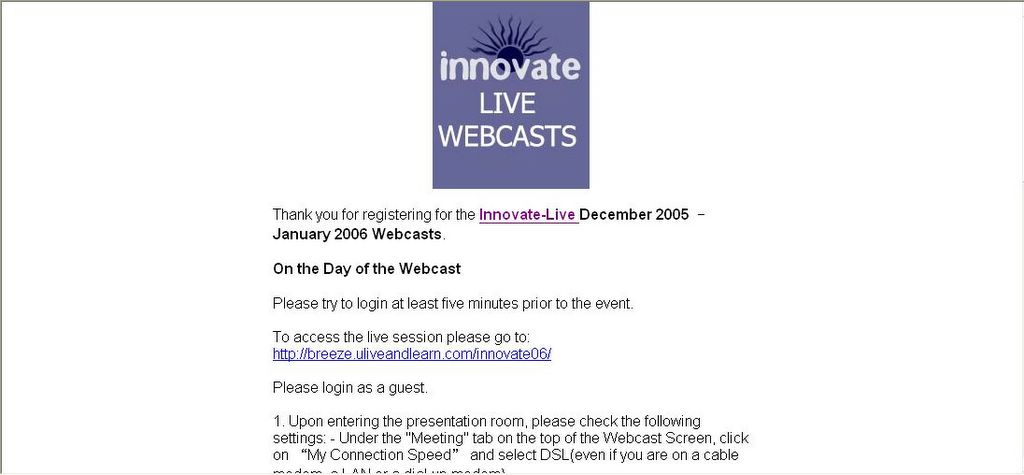
Innovate Live Webcasts

Scheduled Webcasts Applying Gaming and Simulation Techniques to the Design of Online Instruction
Carolyn Rude-Parkins, Karen Hughes Miller, Karen Ferguson, and Robert Bauer
December 12, 2005, 12p.m.EST

Technology and Pedagogy: Building Techno-pedagogical Skills in Preservice Teachers
Lorraine Beaudin and Corey Hadden
December 12, 2005, 1p.m. EST

Taking a Journey with Today's Digital Kids: An Interview with Deneen Frazier Bowen
James L. Morrison and Deneen Frazier Bowen
December 14, 2005, 1p.m.EST

Implementing Organic Education: An Interview with Hugh Osborn
James L. Morrison and Hugh Osborn
January 10,2006, 3p.m. EST

Designing e-Portfolios To Support Professional Teacher Preparation
Tu Tran, Robert Baker, and Margo Pensavalle
January 11, 2006, 3p.m.EST

All times are in EST. The world clock site http://www.worldclock.org might be helpful in converting to your specific time zone.  Posted by Picasa

Saturday, October 29, 2005

Learning University


Each week prior to Learning 2005 we will post video, audio and text segments to trigger conversations and dialogues in the learning field. All content is in the public domain and accessible to all. Get started now with Free Content from Learning 2005!
 Posted by Picasa

Saturday, September 24, 2005

learning environment

Many thanks for your email, Arnold. :-) I was hoping that some of the teachers in this group would jump in and asnwer your question... I'll give it a shot and please feel free to share your ideas and opinions:

I would like to quote a text from productive learning environment,
"What is a learning environment? A learning environment is all the influences that surround a learner and cause him or her to be interested in learning.

In order to help learners learn, one of our main tasks is to create a good learning environment."


And in creating a good learning environment, it has to to be productive so learners could be productive, too. This can be done in many ways. One is through seating arrangements. I think Mei has a lot of experience on this matter :-) In addition, the classroom has pictures, teachers tell stories, classmates are friendly, student sing songs, interesting information, a caring teacher, and a comfortable classroom that surrounds the students. In a productive enviroment, students are excited about learning. They like working with friends, asking questions, and playing games.

There are a few factors that we need to consider in creating a productive learning environment. They are:


physical conditions: Is the classroom too hot? Too cold? Too dark? Is it clean and tidy? Are there enough desks and seats? Are they safe?
¡Pclassroom layout: Is there a chalkboard? Does the teacher use good teaching aids? Do the learners have books and paper and pencils? Are they easy to reach and use?

roles and rules: Do the learners know how to answer questions? Do they know how to ask to leave the room? Do they know the rules when working with other learners?

learners' relationships: Are the learners fighting? Do they like their teacher?


I think many of the conflicts that arise in language schools are more related to factors 3 and 4, roles and rules, and learners' relationship.


The issue on teaching style that was discussed here has something to do with factor 4. The student simply did not like the teacher. This issue was also brought up a few months ago by April when she moved to a new school. The students were reluctant to have a new teacher. There were attitude problems, but I think all this have been resolved, right April?


Acccording to the learning environment program,

Learners' relations with the teacher could be improved when teachers show or exhibits the following behaviors:


the teacher should model caring behaviour: being gentle, smiling, asking questions, helping learners if they have trouble, asking learners to help other learners.
learners should feel free to ask the teacher questions.
learners should feel free to talk to the teacher outside of the classroom.
learners should feel free to touch or hug the teacher if they wish. (This varies from culture to culture.)


I would appreciate comments from the teachers in this group. Do you agree or disagree with any or points made above? Any opinions, suggestions, clarifications?


I look forward to hearing from you.


I've got to go and attend the conference at Wen Zao where I hope to meet Joy.


Cheers everyone!


aiden


arnold wrote:

Hmm. I think you've got many different implicit questions here (no doubt
related here and there). I'd like to have a closer look at teaching and
learning styles perhaps and the implications thereof.

Obviously different teachers teach differently, they have their own
different styles - much in the same way that students also differ in the
ways they learn (best) or think they learn (best). Where they necessarily
meet (in the classroom situation), how much tolerance and patience is there
among both parties to "deal" with these differences. On either side there
will always be a degree of "otherness from how one would like to see things
done oneself" that cannot be ironed out for the sake of a theoretically
perfect match. It is an illusion to think this could be done and a mistake
probably that it should be done.

I think neither the teacher nor the students should be scrutinized too
heavily on this point. Maybe we should concentrate more on the learning
environment instead.

The richer and varied the learning environment that teachers and students
create together is, the less important it is to give a lot of attention to
the notion of different teaching and learning styles. I think that teaching
or learning to (assumed) styles can be so intrusive that it may stunt the
development of the various other learning powers that are always latent in
every student.

Assuming there is some sense in the above assumptions and I would like you
to bear with me on this point, one key question to start with would be:

What are charactistics of such a language learning environment?

Wednesday, September 21, 2005

CEF conference in Kaohsiung


http://www.lttc.ntu.edu.tw/cambridge/CEF/CEFinvitation.htm CEF(Common European Framework of Reference for Languages: Learning, teaching, assessment)  Posted by Picasa

Thursday, August 11, 2005

Reflective teaching: Exploring our own classroom practice


Reflective teaching: Exploring our own classroom practice
Julie Tice, Teacher, Trainer, Writer, British Council Lisbon


Reflective teaching means looking at what you do in the classroom, thinking about why you do it, and thinking about if it works - a process of self-observation and self-evaluation. By collecting information about what goes on in our classroom, and by analysing and evaluating this information, we identify and explore our own practices and underlying beliefs. This may then lead to changes and improvements in our teaching.
 Posted by Picasa

Thursday, August 04, 2005

Scholar Google Search


Online search is getting better and better, not to mention- easier! Posted by Picasa

My Lesson Plan published in IATEFL Computer Special Interest Group


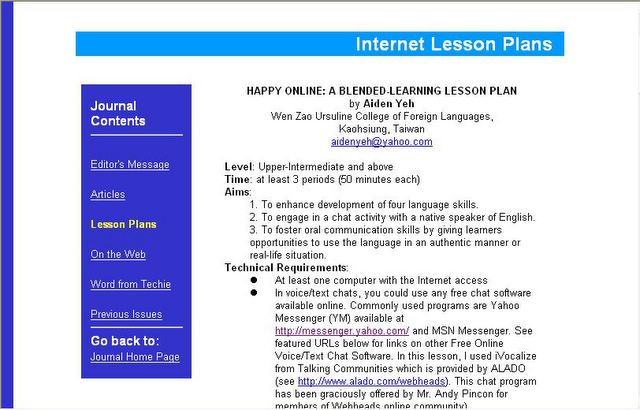
HAPPY ONLINE: A BLENDED-LEARNING LESSON PLAN

by Aiden Yeh

Wen Zao Ursuline College of Foreign Languages,

Kaohsiung, Taiwan
 Posted by Picasa

Wednesday, August 03, 2005

Who needs Education schools?


EDUCATION / EDUCATION LIFE | July 31, 2005
Teaching for Teachers: Who Needs Education Schools?
BY ANEMONA HARTOCOLLIS
What colleges teach. What teachers need to know. And why they're not the same. Posted by Picasa

Great Articles on Blogs


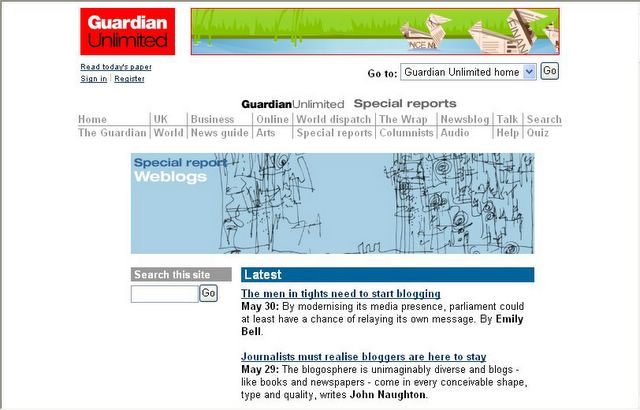
Special Report on Blogs, Guardian Unlimited Posted by Picasa

Saturday, June 25, 2005

Online discussion at Alado


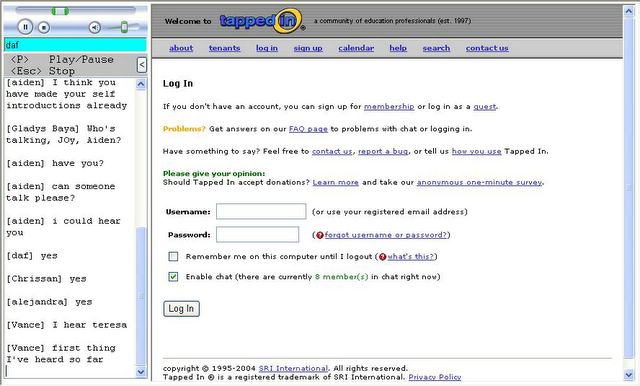
Online Discussion at Alado, June 25, 2005 Posted by Hello

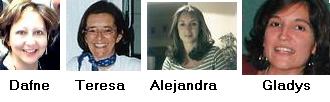
The online discussion started later than scheduled because of me. I had a technical problem: my mic wasn't working. I thought that it had something to do with some malfunctions on my keyboard. All the people present were very helpful, providing me suggestions on how I could make my mic work. But after working on it for 15-20 minutes, I just had to give it up because time was running out. Dafne offered to repeat or reading what I've written on the text board. It worked but it was a bit frustrating because I really wanted to be 'heard'. Nonetheless, the session went smoothly. Alejandra, Gladys, Dafne, Teresa, Chrissan all made wonderful contributions. Sus and Vance dropped by to say 'Hi' and this somehow made me feel relaxed and confident that everything would be alright. Why? Because webheads were there. Greta, a student of mine, also dropped by. She even managed to say a few words.

Here are the main points that were discussed during the session: pre-writing, picture description, email exchange, and blogs [which would integrate all other activities that were discussed]. There were many suggestions that were given and like what everybody else online said, it would take time to be able to practice everything that was discussed tonight. But what is important is that we were able to encourage Joy to start thinking about other activities that could make writing more fun for her students. We will just wait and see whether she'll use some if not all the things that were discussed tonight. Like any other meetings or conferences, the time is always not enough to discuss everything that we wanted to share. But we did, however, achieved the goals of this session.

This session was recorded and uploaded online, and it can be viewed at http://dcyeh.com/aiden_phd/session1.htm

The recording is still uploading as I write this, it is a huge file, afterall.

I hope that it gets uploaded, 'will let you know.

aiden

Happy birthday, Gladys!


Happy birthday, Gladys! Posted by Hello

Click play to hear the music.

Many thanks for spending a few hours of your special day with us, Webheads and Joy. We will never forget this event. Happy birthday once again and may you have many more to come!


Online Discussion on Teaching Writing to Young EFL Learners


Online guests for Aiden Yeh's online discussion on teaching writing to young EFL learners. This online session is part of Joy Chiu's teacher development training program.  Posted by Hello

What: Online chat
Time: 9:30 pm Taiwan time
Place: Alado, http://www.aladonet/webheads
Login: Type your name, No need for password, click 'enter'
Date: June 25, 2005, Saturday

Topic of discussion: Teaching writing to young learners
For: Buxiban teachers

Guests: Teresa Almeida D'Eca, Gladys Baya, Alejandra Weser, Prof. Dafne Gonzalez

Online Resources for Teachers of Young Language Learners [Reading and Writing], click here.

Friday, June 24, 2005

Attention: Mei

This message goes to Mei, who I find quite difficult to find :-( these days.

Mei, I saw your brief message on my tag board. Thanks for the message :-) I am not sure if you have changed your email address since you mentioned that you have not been receiving emails from me. Could you please let me know your new email address?

The group still meets at our YG, click here to go there.

Here's an update of what we've been doing lately and what we will be doing in the following weeks.

Joy Chiu [Fina] will be observing her Writing class at her new school, Garden, today, June 24, Friday. She will record her class. To do this, I lent her my videocamera which she will be returning in a week. Fina also be joining an online discussion with other foreign teachers who have various experiences in teaching writing to young EFL/ESL students. This online session is scheduled tomorrow, on Saturday at 9:30 pm Taiwan time. The place of the chat is at Alado, http://www.alado.net/webheads to go there, just click on the link above. Click on 'Log in', enter your name, NO need for password, and click 'Enter'

I hope that you could make it tomorrow.

You asked me if there's anything you could do for me. Well, my answer is YES, I'm asking a very big favor and I would be deeply indebted if you could help me on this one.

First, you will need to think of an area in your teaching that you would like to learn more, improve or enhanced. Fina chose 'teaching writing to young students', what about you? The area is not limited to learning skills but could we also explore classroom management, if you want.

Second, you will need to observe your class, record on video for observation purposes, then, we will ask the experts to contribute their knowledge and opinion about your query.

Third, observe your class again for the second time, this should be done after we talked to the experts.

If this isn't clear to you, please let me know and I'll explain it in detail.

I hope to hear from you, Mei.

Cheers,

Aiden

On sharing...

I visited NNEST Caucus's blog and I know that Lucie has been working real hard to keep the site going. In one of her rumblings ;-) she mentioned something about sharing and this has caught my eye. I've touched on that topic here on my blog and on our Taiwanese YG, and now it has resurfaced again, this time on an international caucus group.

I posted a comment and here's what I wrote:

Hi there,

Apologies for not being so active lately. I've been busy with school, wrapping things up- now that we're on our last week of school. But I still have to take care of grading a listening and speaking test for an admission test that we gave this week. Anyway, I read your message and this statement caught my attention, "Maybe not ideas about presentations, since we don't want other people to use our original ideas, write the same proposal, and compete against us." You know, Lucie, I think, this is the very culprit why people hesitate to 'share'. I also find this to be true among taiwanese teachers. Having said that, I am beginning to think that this is not a cultural thing. It happens everywhere and to all of us. It's part of being human. People are willing to share for as long as it they deem it safe and productive. However, people also tend to protect themselves and their personal interests, as well. Just like what you said about competing with each other. If you let your guards down, there is always that fear that others may take advantage of the situation [vulnerability or whatever that is].

aiden
p.s.
you're doing a good job Lucie, keep it up ;-)


This is something that I should keep in mind and should be mentioned in my thesis!!!

aiden

Friday, June 17, 2005

Trial session with Joy and webheads in Alado


Trial-Run with Joy, June 17, Friday, 15 GMT at Alado. Online discussion on teaching writing to young EFL learners is slated on June 25th Saturday, 13:30 GMT also at Alado http://www.alado.net/webheads Posted by Hello

Friday, June 10, 2005

in response to Alejendra [call for experts]

Many, many thanks Alejendra. I was thinking about my use of the word 'expert'; it sounds 'daunting', is it?

The online discussion is not intended to be a formal lecture. It's more like sharing about what you've been doing in your writing class, things that have worked with your students, and activities that are fun and stimulating. I have been out of the 'TEYL' (Teaching english to young learners' stream for a long time, and I think that I'm not doing quite a good job with my own children. It's difficult teaching your own children. In my case, I get too cranky. My expectations just shoots up and down. I'd rather hire a tutor to do formal lessons. My husband and I occassionaly speaks English to our children but this isn't enough. Miki (my husband) isn;t worried, though.

Anyway, I think Joy and I could learn a lot from your experience. I'll let you know when the fixed date is, ok?

Thanks!

Hugs,

aiden
p.s.

I'm also collecting URL links to teachers' online resources on teaching writing to kids. If you know of any, I'd appreciate if you could pass them along. :-)

aleweser wrote:
Dear Aiden and Joy,
I have classes every other Saturday, but if I happen to be at home on
the day you plan your webcast you can count on me to share my
experience. Not that I consider myself the expert you are looking for
but I have been teaching 6th graders (11-year-olds) for over twenty
years now so I might have a few ideas to share and I have no doubts
there will be a lot more I can learn from you.

I really look forward to hearing from you.

Alejandra Weser

call for experts on teaching writing to young efl learners

Dear Webheads,


As some of you may know, I’m doing my post grad studies on Taiwanese teachers’ professional development. I am now on the 2nd stage of my research. I have three Taiwanese EFL teachers teaching at supplementary schools (cram schools) who have agreed to take part in my research. Two have created blogs to help them reflect on their teaching and things that they want to learn. We are now about to go to the observation phase. This phase is divided into two stages, before and after the online discussion/lecture/sharing (I still don’t know what to call it). Joy (one of the teachers who agreed to participate in my study) will have to document her teaching, in particular, how she teaches writing (her choice). She will then join an online discussion where my invited ‘expert’ will talk about/share some tips and fun activities that could motivate students.


Joy works Mon-Sat (am) and is willing to devote Saturday evenings (anytime from 13-15 GMT – an hour to an hour and a half) for special online discussions where she could learn something invaluable and something that she could do in her own classroom.


My dilemma is I need an expert on this topic, teaching writing to young learners. You do not have to be a teacher trainer, but you must at least know and have experienced teaching writing to young students. If you know some successful writing activities that you would like to share with Joy, then I also encourage you to join us.


This online discussion/sharing will not only be part of my study but most importantly, part of Joy’s professional development. Many Taiwanese EFL teachers in private language institutions share the same fate that Joy is experiencing: lack of teacher training support from the government and from the school that she works for. TPD for these teachers are considered to be unimportant because they are after all, what many locals consider ‘just a language school teacher’. Compared to Elementary school/high school/college English teachers, they are not really recognized as ‘teachers’. However, this does not mean that they are not good enough. I know some language school teachers whose English proficiency is far better that junior college teachers. I believe that with the right support and encouragement, these motivated teachers could experience the personal satisfaction of engaging in TPD. Joy has created her blog where she posts her thoughts and opinions about things that she’s learned in f2f conferences. She has attended 3-4 local conferences, and in one of these conferences, she was the only language school teacher who attended- the rest where college/university teachers. She was not intimidated by this, as a matter of fact, she was very active, participated in the session, and even raised some questions. Other teachers who were present were not as active as she was.


You may say that she’s different. But what makes her different is her tenacity to learn and improve herself (like Webheads)- all this without financial remunerations or the constant prodding of an employer or teacher. I think that she’s not at all different from the rest of us.


If you are interested in sharing your knowledge and skills with Joy, and if you are willing to spend an hour (or perhaps an hour and half) discussing some fun activities on teaching writing for young EFL students, then please, join us.


There is no fixed date yet, but it’s going to be a Saturday, 13-15 GMT, probably Alado or Learning times.


Many thanks in advance and I hope to hear from some of you.


Cheers,


Aiden Yeh

teaching writing [response to Joy]

Many, many thanks for your email. It's certainly nice to hear from you. So, you've finally accepted the job offer from Garden. That's good news. How is it?

With regards to your topic, I think that it is very interesting. I'll line up some topics and will get in touch with lecturers. Saturday night is cool.

I'll keep you updated.

aiden

Chiu Joy wrote:
Dear Aiden,

Sat nights are fine. Just let me know which day.
And because I've just started my only new class at Garden
this week, I need a little time to set up the class.
The observation will take place once before and once after
the online lecture, right?

So as soon as you lend me the equiment (let's say,
sometime between mid June and the begining of July),
I should be able to record the first part.

As to the second time, maybe you can come in if
you like. Or I can tape it, but first we need to schedule
a date for the on-line lecture. The topic I want to discuss:
ways/methods/games/activities that help Ss learn how to write.

I guess I need to be more specific, but I don't have a clear
idea myself yet. Will let you know later.

Look forward to the online lecture already!!!
Talk to you soon.

PS. I've got so many wonderful experience with Garden.
But don't have time to put them on my Blog yet.
Hopefully, I can have that done this weekend!!!


Fina aka Joy

Need help badly

Hello guys,

This is an urgent call- a very, very urgent call for help ;-)

I need to start doing my observation, and as you know, time is running out. I know you have been very busy with your careers, some of you may be starting new ones, some of you, maintaining and rejuvenating your jobs. Likewise, I have been very busy too and I'll be starting online courses this summer, not to mention, my f2f (face-to-face- classes in Wen Zao). Your blogs (Mei and Fina) have been very successful and I would like to congratulate you on that. Not many teachers, even in higher education, have the willingness and tenacity that you guys have. April? When are you going to start your own?

The messages that you've posted on our taiwanese-efl-yahoogroups have been very helpful and the reflective approaches have somehow influenced your professional development. I hope that you all will continue on what you have started.

Now, back to the purpose of this letter ;-)

I want us all to participate in a more active stance of your tpd (teacher professional development). I really wanted you to engage in an online lecture to be conducted by one of my invited foreign guest lecturers. I've got so many volunteers. I asked you one time about the time and date of your availability and many of you wrote Saturday, evening, so I am looking at Saturday evening from 8-11 pm. The session won't last that long but will go on for an hour or an hour and a half. This is what I want you to do (you must do!)

1. Think of a topic that you would like to learn more. This must be classroom oriented i.e. teaching reading, teaching spelling, teaching grammar, or even classroom management. The topics may vary and the topics may be divided into 2-3 online sessions. We could line them up.

2. Based on what you will be learning online, you will then practice or adapt in your classroom the things that you learned from the online sessions. This will be observed by me or via video (which I could lend you for observation purposes).

Are you ready for this?

If you don't have computers at home, please let me know so I could arrange for us to meet at home and we'll have a blended learning session (I'll provide the computer, internet and webcam so we could meet our online guests).

Are you with me so far?

If you're experiencing any difficulties with my requests, I would appreciate if you could let me know ahead of time.

Many, many thanks and I look forward to hearing from you.

Aiden

Friday, May 06, 2005

NNESTs Topics and Issues

As posted to TESOL's NNEST-list serve on May 06, 2005

Hello everybody,

I hope that after reading the newly circulated newsletter you now have some ideas for TESOL 2005 caucus presentations. Two weeks have passed and nothing has been said much about this. I'm wondering if it's possible to pair people- like pairing the novice with the experts. This will help novice NNESTs to experience presenting in TESOL. I'm not sure if some of you will even consider doing this but I think it will be a good chance to encourage others to share what they know.

Presenting in TESOL can be overwhelming sometimes. It takes a lot of courage and confidence. It is only when we believe that we could do it can we come out and shine like a star. NNEST list serve is like any other online groups. We're striving to make a sense out of our participation from this group. The content and tone of our messages posted to this list create a virtual environment showing how friendly, welcoming and professional our community is :-) (or at least we try to be). A member's success (whether it's a scholarship, book releases, presentations in conferences, etc.) is our group's pride and achievement as well. We have 179 members, more or less, yet I don't think that all 179 have actually participated either in discussions or presentations. Now, we are here because we share a common cause. Let's continue where our great leaders and moderators have left off.

Let's start sharing.

Sharing. It's a simple word but loaded with meaning. The act of sharing could also be influenced by our culture and traditions. Many people may find it difficult to share because there are consequences: job security, insecurity, self-interests and what have you. Do you sometimes feel afraid that somebody might steal your ideas? Has our profession really been commercialized to the point that it has become a dog-eat-dog business?

As NNESTs do we often rant about the NS-NNEST dichotomy, compare salaries and benefits, and worse, compare skin colors. 6 years ago, I used to get carried away with these topics. My MSc thesis is heavily based on these issues! It was only 3 years later when I realized that I've had enough. To constantly look at the differences won't make me feel any better; it does not alleviate the situation. The discrepancy will always be there. That's when I thought of a topic for my PhD research, NNESTs' teacher professional development (TPD). Many of us here have completed our MAs and MScs and others are in the process of obtaining theirs. But in our own local contexts, a huge number of NNESTs in private institutions are not as lucky as some of us are. They don't have access to good trainings. What can we do to help them? Do you have any ideas on how to encourage the less privileged teachers to engage in TPD?

Apologies for this long post! I easily get carried away ;-)

Anyway, I hope that this gives you some fresh ideas for your (individual or team work) presentations. When submitting to TESOL, make sure that you submit at least two proposals because the acceptance rate is low (thanks to lucie for this reminder). but this should not discourage you to submit- think of it as a healthy challenge :-)

Aiden